
The sixth century BCE stands out as a transformative period in early Indian history. This era witnessed the emergence of powerful states, urban centers, widespread use of iron tools, and the introduction of coinage—developments that laid the foundation for complex political and economic structures. It was also marked by the rise of diverse philosophical and religious traditions, including Buddhism and Jainism, which would go on to shape Indian thought for millennia.
Most of the emerging territorial units, known as Mahajanapadas, were monarchies. However, some were governed by oligarchies—called ganas or sanghas—where power rested collectively with a group of individuals often referred to as rajas. Each Mahajanapada had a fortified capital city that served as the administrative and military hub. The maintenance of these fortifications, along with growing bureaucratic and military needs, required significant resources.
By the sixth century BCE, Brahmanical scholars began composing texts known as the Dharmasutras in Sanskrit. These texts laid down social and political norms for rulers and other sections of society. Ideally, rulers were expected to belong to the Kshatriya varna and were advised to collect taxes and tributes from cultivators, traders, and artisans.
While some states began to develop standing armies and centralized bureaucracies, others continued to rely on locally recruited militias, often drawn from the peasantry. This period also witnessed the strengthening of varna-based hierarchies and increased dependence on Brahmanical ideology for legitimizing power.
Gana-Sanghas offered a representative form of governance where decisions were made collectively. The head of such a polity was not hereditary and was known as Ganapati or Ganaraja. These polities thrived in or near the Himalayan foothills in eastern India. Public affairs were discussed in a communal hall called the Santhagara, and decisions were made using a voting process involving wooden pieces known as Salakas. An official called Salaka-Gahapaka ensured the integrity of this process.
Gana-Sanghas had a relatively simple social structure, mainly comprising the Kshatriya ruling families and the Dasa-Karmakaras (slaves and laborers). Their tolerant environment allowed thinkers like Mahavira and Gautama Buddha to freely propagate their philosophies.
In contrast, monarchies were centralized, hereditary systems where power rested with the king and his court. These kingdoms were predominantly located in the fertile plains of the Ganga Valley. While early monarchies included advisory councils such as Parishad and Sabha, the increasing association of kingship with divinity gradually diminished the role of such assemblies. Loyalty to caste hierarchies and the ruler was central to the social fabric, and Brahmanical ideology played a dominant role in governance and society.
1. Kashi: Located around Varanasi, Kashi frequently clashed with Kosala, Anga, and Magadha.
2. Kosala: With major towns like Ayodhya and Shravasti, its capital was Saketa. King Prasenajit was a contemporary of the Buddha.
3. Anga: Situated in modern-day Bhagalpur and Munger in Bihar, its capital Champa was a major urban center.
4. Magadha: Encompassing Patna and Gaya districts, Magadha’s capital shifted from Rajagriha to Pataliputra under the Haryanka dynasty.
5. Vajji Confederacy: Located north of the Ganga, it was a confederation of clans including the Lichchhavis and Videhas, governed by a republican system.
6. Malla: West of Vajji, it consisted of a confederacy of nine clans with Kusinara and Pava as its centers.
7. Chedi: Located in eastern Bundelkhand, its capital was Sotthivatinagara, possibly the Shuktimati of epic fame.
8. Vatsa: Known for its fine textiles, it had its capital at Kaushambi. King Udayana’s romance with Vasavadatta is a famous legend.
9. Kuru: Ruled from Indraprastha (Indapatta) by a dynasty tracing its lineage to Yudhishthira.
10. Panchala: Spread across modern Rohilkhand and central Doab, it included the prominent city of Kanyakubja (Kanauj).
11. Matsya: Centered in present-day Rajasthan, its capital Viratanagara (modern Bairat) was linked to the Shurasenas.
12. Shurasena: With Mathura as its capital, its king Avantiputra is said to have been a disciple of the Buddha.
13. Assaka (Ashmaka): Located in the northwest, with its capital at Potali (modern Bodhan).
14. Avanti: Spread across Malwa, it had dual capitals—Ujjayini and Mahishmati. King Pradyota ruled during its conflicts with Vatsa and Magadha.
15. Gandhara: Encompassing parts of present-day Pakistan, its capital Takshashila was a renowned center of learning.
16. Kamboja: Spanning parts of northwest India and modern-day Pakistan, it later evolved into a sangha as mentioned in the Arthashastra.
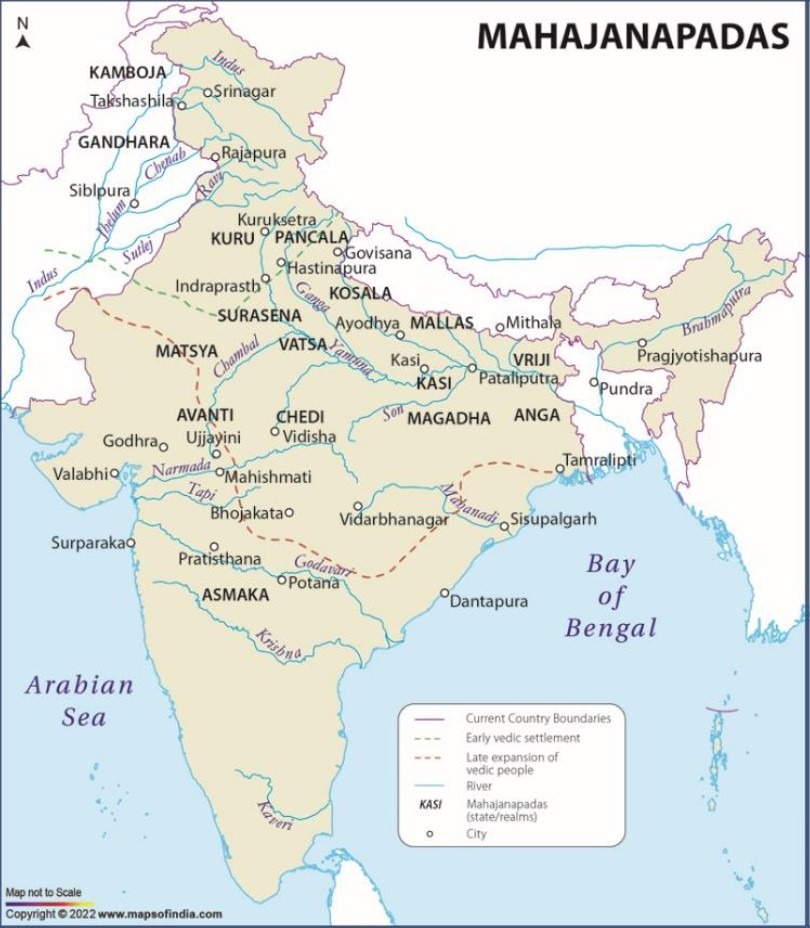
Between the 6th and 4th centuries BCE, Magadha, located in present-day Bihar, rose as the most dominant Mahajanapada in ancient India. Historians attribute this remarkable ascent to several factors. The region boasted fertile lands, enabling prosperous agriculture, while nearby iron ore reserves in present-day Jharkhand provided the raw material for weapons and tools. The presence of elephants in the surrounding forests gave the Magadhan army a strategic edge. Additionally, the Ganga River and its tributaries facilitated easy and cost-effective communication and transportation.
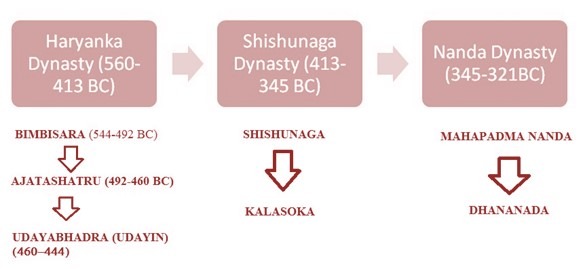
However, early Buddhist and Jaina texts suggest that individual leadership played a critical role in Magadha’s rise. Visionary rulers like Bimbisara, Ajatashatru, and Mahapadma Nanda, supported by shrewd ministers, laid the foundations of a powerful empire through calculated diplomacy, warfare, and administrative reforms. As rival Mahajanapadas engaged in conflict, Magadha emerged as the undisputed center of political gravity in ancient India.
Magadha’s journey to supremacy began under Bimbisara, who ruled for 52 years. A master strategist, he adopted a three-pronged policy: forging matrimonial alliances, forming friendships with strong rulers, and conquering weaker neighbors. His capital, Rajgriha (Girivraja), was a fortified city nestled amidst five hills, making it nearly impenetrable.
Bimbisara’s diplomatic finesse is evident in his marriage to Mahakoshala, sister of the Kosala king Prasenjit, through which he gained control over Kashi, a prosperous region yielding substantial revenue. His second wife, Chellana, a Lichchhavi princess from Vaishali, gave birth to Ajatashatru. His third wife, Khema, hailed from the Madra clan of Punjab. His alliance with Avanti evolved from rivalry to friendship, as seen when he sent his royal physician Jivaka to treat King Pradyota of Avanti.
Bimbisara’s son, Ajatashatru, impatient to rule, reportedly killed his father and seized the throne. He is remembered as the most powerful and aggressive ruler of the Haryanka dynasty. Continuing his father’s expansionist legacy, Ajatashatru annexed Kosala after a fierce conflict with his maternal uncle Prasenjit. He also waged a 16-year-long war against his grandfather Chetaka of Vaishali, ultimately subduing the powerful Lichchhavi confederacy.
Ajatashatru introduced innovative military technologies, such as the Mahashilakantaka (a catapult-like war engine) and the Rathamusala (a chariot equipped with maces for mass killing). Anticipating threats from Avanti, he fortified Rajgriha extensively. Notably, Gautama Buddha passed away during his reign, and Ajatashatru played a key role in convening the First Buddhist Council.
Ajatashatru was succeeded by his son Udayabhadra (Udayin), who shifted the capital from Rajgriha to the strategically located Pataliputra (modern Patna), situated at the confluence of the Ganga and Son rivers. This move positioned Magadha at the heart of its expanding empire. Udayin’s reign, however, was cut short—he is believed to have been assassinated at the behest of Palaka, king of Avanti.
The Shishunaga dynasty succeeded the Haryankas. Shishunaga, formerly a viceroy in Varanasi, was chosen by the people of Magadha, who were disillusioned by the violent successions of Udayin’s heirs. Shishunaga temporarily shifted the capital to Vaishali and is best known for defeating the Pradyota rulers of Avanti, thereby ending a century-old rivalry and integrating Avanti into the Magadhan empire.
His son and successor, Kalasoka (Kakavarna), presided over a period of relative peace. The Second Buddhist Council was convened in Vaishali during his reign to address monastic disputes, showcasing the continued royal patronage of Buddhism.
Following the Shishunagas, the Nanda dynasty rose to power around 345 BCE, founded by Mahapadma Nanda, often referred to as Ugrasena in Pali texts for his formidable army. Unlike previous dynasties, the Nandas were non-Kshatriyas, with Mahapadma believed to be the son of a Shudra woman, according to the Puranas. This status led to Brahmanical texts labeling the Nandas as adharmika (outside the bounds of traditional Dharma).
Mahapadma Nanda was the first empire builder of India, claiming the title of Ekarat (sole ruler) and Sarva-Kshatrantaka (destroyer of Kshatriyas). He expanded Magadhan control over Kalinga and Kosala, reportedly bringing back a Jina idol as a trophy from Kalinga. His reign was marked by systematic taxation, irrigation projects, and administrative reforms.
His son and successor, Dhanananda, is identified with the Greek accounts of Agrammes or Xandrames. He ruled over a vast and wealthy kingdom with a massive standing army. However, his arrogance and oppressive taxation led to widespread discontent. This resentment paved the way for the rise of Chandragupta Maurya, who, under the guidance of Kautilya (Chanakya), overthrew the Nandas and established the powerful Maurya Empire.
This dynamic period not only transformed the political landscape of India but also set the stage for intellectual, cultural, and spiritual flourishing. The interactions between monarchies and republican polities, coupled with the rise of new ideologies and economic advancements, make the sixth century BCE a cornerstone of ancient Indian civilization.
The Pre-Mauryan period marks a significant transformation in the economic landscape of ancient India, particularly in the middle Gangetic plains. This era witnessed the shift from a predominantly pastoral economy to a more advanced agrarian and urban-based system. Cattle rearing, once the primary occupation, gradually gave way to settled agriculture. Rice, especially varieties like Vrihi and Sali, emerged as the staple crop, predominantly grown in regions of Eastern Uttar Pradesh and Bihar.
Iron technology played a pivotal role in this agricultural expansion. The use of iron tools enabled the clearing of dense, rain-fed forests, paving the way for cultivation and permanent settlement. These developments laid the groundwork for a more structured rural economy, which in turn became the backbone of emerging urban centers.
This period is often referred to as the time of India’s second urbanisation. Towns began to emerge not just as residential hubs, but as thriving centers of industry and commerce. Archaeological findings from the Northern Black Polished Ware (NBPW) phase, especially from the 3rd century BCE, show the use of burnt bricks and ring wells—clear indicators of advanced urban planning and infrastructure.
The expansion of agriculture and rural surplus supported the growth of crafts and trade. Taxes and tributes collected from rural areas became essential to sustaining urban settlements and the evolving state structure.
With the growing complexity of economic life, specialized craftsmen began forming guilds (srenis). These early guilds facilitated the procurement of raw materials, streamlined production, and enabled the distribution of finished goods. Historical records mention as many as 18 guilds, each occupying a distinct quarter within a town. Although these guilds were still in their formative stages, they set the stage for the highly organized mercantile institutions that would flourish in later periods.
Trade was further enhanced by the introduction of a monetary economy. Metal coins began to circulate during the time of Gautama Buddha. The earliest hoards have been discovered in Eastern Uttar Pradesh and Magadha, with some even found in Taxila. These coins were likely referred to as Nishka and Satamana, and their use significantly boosted trade efficiency.
Prominent merchants, known as Sresthis (bankers), played a vital role in the economic fabric of this period. Notable among them was Anathapindaka, a wealthy banker from Shravasti who famously donated the Jetavana Vihara to the Buddha. Another renowned Sresthi was Mendaka from Rajagriha, indicating the growing influence and wealth of merchant classes.
Here are some notable economic terms from the period:
The social structure of the pre-Mauryan era was firmly rooted in the Varna system, which categorized society into four distinct classes—Brahmanas (priests), Kshatriyas (warriors), Vaishyas (traders and agriculturists), and Shudras (laborers and service providers). This rigid classification marked the clear transition from tribal communities to a more stratified social hierarchy.
The Dharmasutras, composed during this time, outlined the duties of each varna and provided the framework for both civil and criminal law. While the Brahmanas and Kshatriyas retained positions of power and prestige, Vaishyas were condemned for their role in money-lending, despite their economic contributions. The Shudras suffered the most—they were denied religious rights, legal recognition, and educational opportunities, and were relegated to the lowest social tier.
Patriarchal norms became deeply entrenched during this period. Women were increasingly viewed as subordinate to men and were placed under the lifelong guardianship of male relatives. They were excluded from formal education and religious rites such as the Upanayana (initiation ceremony). These regressive attitudes severely restricted women’s autonomy and participation in social and spiritual life.
The Pre-Mauryan period laid the foundational blocks for the rise of the Mauryan Empire. With the shift to agriculture, emergence of cities, growth of trade, and evolution of complex social hierarchies, this era represents a critical phase in the subcontinent’s journey toward imperial consolidation. Its innovations in economy, governance, and urbanism would be inherited and expanded upon by future dynasties, making it a pivotal chapter in early Indian history.