
TOne Academy

Money

Money

     Money is a key concept in economics that is vital to our daily lives. It facilitates economic activities, and without it, accessing many essential goods and services would be challenging. Comprehending the roles and functions of money is crucial for understanding the broader mechanisms of the economy.


      In today’s economic environment, money and banking are essential forces that influence daily life and national dynamics. Money enables transactions, while banking institutions serve as the backbone of the financial system. This chapter delves into the historical evolution of currencies and the transformative effects of money on economies. It also analyzes the vital role of banking institutions as financial intermediaries, shaping wealth distribution, fostering innovation, and contributing to either economic resilience or vulnerability.

Evolution of Money

     Money is a complex and abstract concept that goes beyond its traditional role as a medium of exchange. It takes on various forms, functions, and characteristics, serving as a societal tool with significant implications for social and cultural dynamics. The evolution of money can be categorized into several stages:


Barter System (Pre-Money): In early human societies, individuals relied on barter to trade goods and services directly, without the use of a standardized medium of exchange. While this system worked effectively on a small scale, it faced significant challenges: inefficiencies hindered transactions, there was a lack of divisibility for certain goods, and the “double coincidence of wants” was a major limitation, as both parties had to want what the other had to offer in order for a trade to occur.


Commodity Money: To address the limitations of barter, societies began to use commodities with intrinsic value as mediums of exchange. Items such as salt, cattle, shells, and precious metals like gold and silver became early forms of money. These commodities were valued for their durability, divisibility, and inherent worth, making them effective tools for facilitating trade and simplifying transactions.


Metallic Coins: As trade progressed, the use of precious metals transitioned into the minting of metallic coins. Governments and rulers began producing standardized coins to guarantee consistency in weight and purity. This advancement created a more convenient and widely accepted medium of exchange, facilitating commerce and enhancing the efficiency of transactions across larger markets.


Representative Money: To overcome the difficulties associated with transporting large quantities of coins, representative money was introduced. This form of money included promissory notes or certificates that could be exchanged for a specific amount of a commodity, such as gold or silver, that was held in reserve. Representative money made transactions more manageable and convenient, allowing people to conduct trade without the need to carry heavy coins.


Paper or Fiat Money: Over time, governments shifted from commodity-backed money to fiat money, which is not tied to a physical commodity but gains its value from public trust and confidence. Fiat currencies are designated as legal tender by governments and are widely accepted for transactions. In India, for example, the Government issues all coins and ₹1 notes under the Coinage Act of 1909, while the Reserve Bank of India (RBI) is empowered by the RBI Act of 1934 to issue the remaining banknotes. This transition to fiat money has allowed for greater flexibility in monetary policy and economic management.


Banknotes and Fractional Reserve Banking (FRB): The rise of banking institutions led to the issuance of banknotes, which represent a claim on a commodity, originally gold or silver. Fractional reserve banking enables banks to lend out more money than they actually hold in reserves, thereby expanding the money supply. This process stimulates the economy by freeing up capital for lending, allowing for increased investment and consumption. Through this mechanism, banks play a crucial role in promoting economic growth and stability.


Electronic and Digital Money: The 20th century heralded the advent of electronic money, starting with the introduction of checks and credit cards. The rise of the internet and technological advancements opened the door to digital currencies and electronic transactions, significantly decreasing the reliance on physical cash. Notable examples include the Digital Ruble in Russia and the eRupee introduced by the Reserve Bank of India (RBI), illustrating the shift towards more convenient and efficient payment methods in today’s economy.


Cryptocurrencies: The 21st century has witnessed the rise of cryptocurrencies, with Bitcoin pioneering this movement. These decentralized digital currencies utilize cryptography for security and are built on blockchain technology, providing a new form of money that challenges the conventions of traditional financial systems. Cryptocurrencies offer unique advantages such as increased transparency, reduced transaction costs, and enhanced accessibility, while also raising new questions about regulation and the future of monetary policy.

Functions of Money
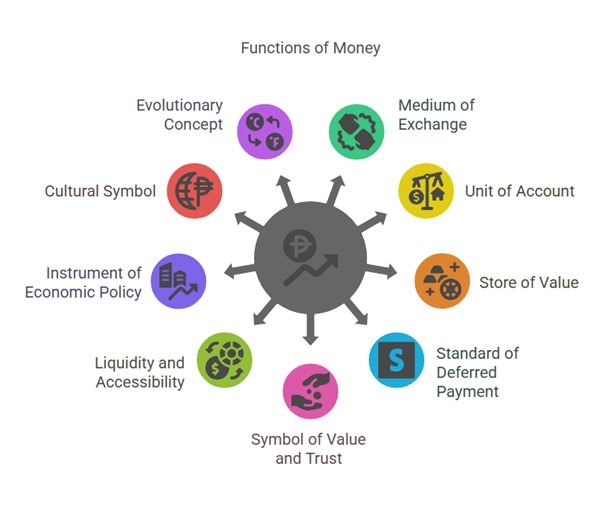


Medium of Exchange: Money functions as a universally accepted medium that allows individuals and entities to facilitate the exchange of goods, services, or assets. This role enhances transactional efficiency by eliminating the complexities of barter, making it easier for parties to trade and transact in the economy.


Unit of Account: Money serves as a standardized unit of measurement for valuing goods, services, and assets. This function enables a common framework for economic transactions, allowing individuals and businesses to assess, compare, and allocate resources effectively.


Store of Value: Money functions as a repository of wealth, enabling individuals to save and preserve economic value for future use. It serves as a durable and transferable asset over time, allowing people to maintain their purchasing power and invest in future opportunities.


Standard of Deferred Payment: Money facilitates agreements for future transactions by acting as a reliable medium for deferred payments and contractual obligations. This function allows parties to make commitments for payments that will occur at a later date, providing a clear framework for settling debts and fulfilling agreements over time.


Symbol of Value and Trust: Money serves as a symbolic representation of value and trust within a society, reflecting collective beliefs, economic stability, and confidence in the integrity of the financial system. Its acceptance and use are rooted in societal faith in its worth, making it a fundamental cornerstone of economic interactions.


Liquidity and Accessibility: Money is characterized by high liquidity, meaning it can be quickly and easily converted into goods, services, or other assets. This feature provides individuals with flexibility and ready access to resources, allowing them to respond swiftly to their economic needs and opportunities.


Instrument of Economic Policy: Money serves as a crucial tool for governments and central banks in implementing monetary policies. Through the management of money supply and interest rates, these institutions can influence inflation, promote economic growth, and maintain overall economic stability, shaping the financial environment in which businesses and consumers operate.


Cultural Symbol: Beyond its economic functions, money often carries cultural significance, reflecting the historical, political, and social facets of a community. The designs and symbols on currency can encapsulate a nation’s identity and heritage, serving as a representation of shared values, cultural narratives, and national pride among its people.


Evolutionary Concept: Money evolves over time, adapting to technological advancements and changes in societal structures. It has transitioned from traditional physical forms such as coins and banknotes to encompass digital and virtual currencies. This evolution allows money to meet the ever-changing demands of a dynamic world, facilitating efficient transactions in an increasingly digital economy.

Exchange rates

      Exchange rates indeed play a significant role in international economics by determining how much of one currency is needed to purchase a unit of another currency. This affects international trade, investment decisions, and overall economic relations between countries.

The Fixed Exchange Rate System operates as follows:

    • Pegged Value: A country’s currency is fixed at a set rate against another currency or a select group of currencies, ensuring stable exchange rates.


    • Intervention Required: To maintain this fixed rate, governments or central banks actively intervene in the foreign exchange market. This involves buying or selling their own currency to offset fluctuations.
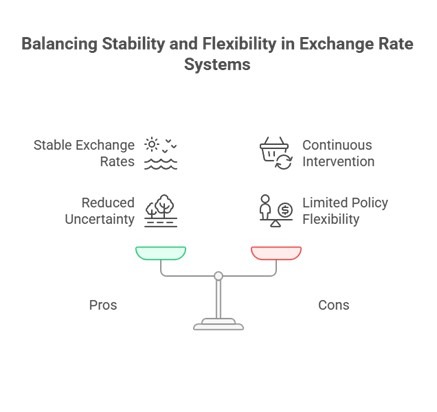
    • Pros:
        • Stability: Provides consistent exchange rates, making international trade and investment more predictable.


        • Reduced Uncertainty: Businesses and investors benefit from reduced risk of sudden currency fluctuations.


    • Cons:
        • Continuous Intervention: Requires frequent intervention in the currency market, which can be resource-intensive.


        • Limited Monetary Policy Flexibility: Limits a country’s ability to adjust its own monetary policy as needed to address domestic economic conditions, since maintaining the peg is the priority.


This system emphasizes stability and predictability over flexibility, impacting how nations engage economically both internally and globally.

The Floating Exchange Rate System functions with the following characteristics:

    • Market-Driven: The value of a currency is primarily determined by supply and demand in the foreign exchange market. This means that a currency will strengthen if demand for it increases or if its supply decreases, and vice versa.
  •  
    • No Fixed Rate: Unlike fixed systems, currency values fluctuate freely, adjusting according to market conditions and economic indicators, such as inflation rates, interest rates, and economic performance.
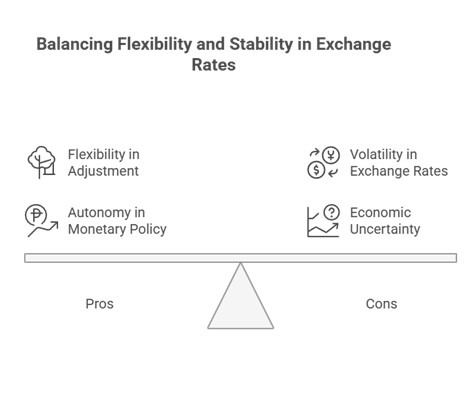
    • Pros:
        • Flexibility: Allows for automatic adjustment of currency values in response to external economic factors, which can help countries absorb and adapt to economic shocks

.

        • Autonomy: Countries retain greater control over domestic monetary policy since they do not need to maintain a currency peg.


    • Cons:
        • Volatility: Exchange rates can change rapidly, leading to potential uncertainty in international trade and investment.


        • Economic Uncertainty: Businesses and governments may face challenges in budgeting and financial planning due to unpredictable currency movements.

The floating exchange rate system provides a dynamic and responsive way to manage economic conditions, though it comes with the challenge of managing possible instability and unpredictability in exchange rates.

The Managed Float (or Dirty Float) Exchange Rate

The Managed Float (or Dirty Float) Exchange Rate System combines elements of both fixed and floating systems, featuring the following:


    • Hybrid Approach: While the currency is generally allowed to float according to market forces, it is subject to occasional interventions by central banks or governments. These interventions aim to influence the currency’s floating rate to avoid extreme fluctuations.
  •  
    • Purpose of Intervention: The main goals are to prevent excessive volatility, stabilize the currency within a desired range, and occasionally guide the exchange rate towards specific economic objectives, such as controlling inflation or maintaining competitiveness.
  •  
    • Pros:
        • Balance: Offers a middle ground, providing the flexibility of a floating system while still achieving some stability through intermittent intervention.
        • Adaptive: Allows policymakers to respond to short-term disruptions and help stabilize the economy.
  •  
    • Cons:
        • Continued Volatility: Despite interventions, exchange rates can still be volatile, which might lead to market uncertainty.
        • Potential Ineffectiveness: Interventions may not always be successful in achieving desired outcomes, particularly if market forces are strong.


This system aims to harness the benefits of both fixed and floating rates, maintaining market mechanisms while allowing for state intervention when deemed necessary to preserve economic stability.

Evolution of Exchange Rate System in India

Pre-Independence Era

During the Pre-Independence Era under British colonial rule, the Indian rupee was pegged to the British pound sterling. This arrangement had several implications:
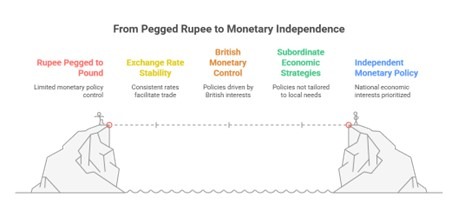


    • Exchange Rate Stability: By tying the rupee’s value to the pound, India benefited from consistent and predictable exchange rates, facilitating trade with Britain and its colonies.
  •  
    • Monetary Control: The exchange rate system was controlled by British economic policies, leaving India with little to no autonomy over its own monetary policy. Decisions about currency valuation and economic adjustments were primarily driven by British interests.
  •  
    • Economic Impact: While the stability supported trade with Britain, it also meant that India’s economic strategies and policies were largely subordinate to those of the British economy, limiting the ability to tailor policies to local economic conditions or developmental needs.


This period set the stage for post-independence economic policy development, as India sought to establish greater monetary independence and restructure its financial systems in line with national interests.

Bretton Woods System (1944-1971):

During the Bretton Woods System period from 1944 to 1971, India was part of a global agreement that established fixed exchange rates with currencies pegged to the U.S. dollar, which was convertible to gold. For India:
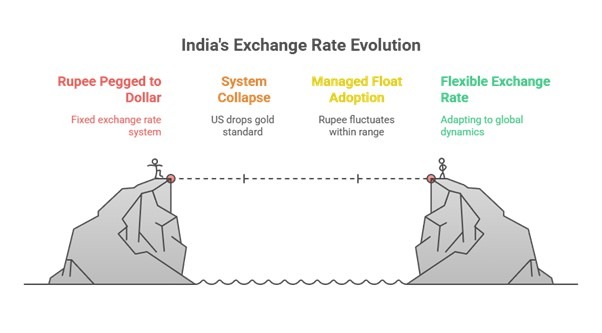


    • Peg to the U.S. Dollar: The Indian rupee was pegged to the U.S. dollar, providing stability and facilitating international trade under a system designed to encourage economic cooperation and reconstruction post-World War II.
  •  
    • Fixed Exchange Rate Benefits: This arrangement offered the benefits of stable exchange rates, aiding in planning and trade with major global economies.
  •  
    • Collapse in 1971: The system ended when the U.S. dropped the gold standard, effectively dismantling the fixed exchange rate regime as the dollar’s convertibility into gold was suspended, leading to more flexible exchange systems globally.
  •  
    • Transition to Managed Float: Post-1971, India adopted a managed float system, where the rupee was allowed to fluctuate within a specified range, and the Reserve Bank of India (RBI) intervened as needed to stabilize the currency and address economic needs.


This transition marked a shift towards greater flexibility in managing India’s exchange rate, allowing more room for domestic economic policy-making and adaptation to global financial dynamics.

1975-1991: Controlled Float and Periodic Devaluations:

Between 1975 and 1991, India managed its exchange rate through a controlled float system characterized by:


    • Controlled Float: While the rupee was allowed to float, the exchange rate was heavily managed within tight limits by the Indian government and the Reserve Bank of India. This control aimed to strike a balance between stability and the flexibility needed to respond to economic conditions.
  •  
    • Periodic Devaluations: During this time, India periodically devalued the rupee to make Indian exports more competitive in global markets. This was part of an effort to address the country’s persistent balance of payments issues, aiming to reduce the trade deficit by making exports more attractive and imports more expensive.
  •  
    • Basket of Currencies: The rupee’s value was stabilized not just against the U.S. dollar but against a basket of currencies, reflecting India’s diverse trade relationships.


This period of managed exchange rates was marked by significant government intervention aimed at stabilizing the rupee while trying to foster economic growth under challenging circumstances, leading to the broader economic reforms of the 1990s.

1991 Economic Reforms (Floating exchange rate system):

The 1991 Economic Reforms marked a significant turning point in India’s economic policy, particularly concerning the exchange rate system:


    • Shift to Liberalization and Globalization: In response to a balance of payments crisis and economic stagnation, India implemented wide-ranging economic reforms that included liberalization, globalization, and privatization. These reforms aimed to open the economy to market forces and reduce government control.
  •  
    • Adoption of a Floating Exchange Rate System: As part of these reforms, India transitioned from a controlled exchange rate to a more market-determined floating exchange rate system. The government reduced its direct involvement in managing the exchange rate, allowing supply and demand dynamics to primarily dictate the rupee’s value.
  •  
    • Market Forces: With the market playing a more significant role, the rupee began to reflect economic fundamentals more accurately, responding to changes in trade, investment flows, and overall economic conditions.
  •  
    • Increased Export Competitiveness: The floating exchange rate system enhanced the competitiveness of Indian exports by allowing the currency to adjust naturally to market conditions, making Indian goods more attractive in global markets.
  •  
    • Sustainable External Position: The reduction in government intervention contributed to stabilizing the economy and improving India’s external balance, helping to attract foreign investment and promote economic growth.


This transition laid the foundation for India’s integration into the global economy and marked the beginning of a new era of economic development for the country.


Indeed, the transition from a fixed to a more flexible exchange rate system in India embodies the nation’s broader economic journey characterized by:

    • Greater Autonomy: Moving away from fixed exchange rates has allowed India to exercise more control over its monetary policy, enabling the government and the Reserve Bank of India to make decisions that align with domestic economic conditions and priorities rather than being bound by external influences.
  •  
    • Integration into the Global Economy: By adopting a flexible exchange rate regime, India has been able to engage more dynamically with global markets. This engagement fosters trade relationships and facilitates foreign investments, contributing to economic growth and resilience.
  •  
    • Competitive Edge: The flexibility in the exchange rate has enhanced India’s competitiveness in international markets. A market-determined currency can adjust to reflect economic fundamentals, improving the attractiveness of Indian exports and supporting the balance of payments.
  •  
    • Adaptability to Economic Shocks: A flexible exchange rate system allows for automatic adjustments in response to external economic shocks, helping the economy to absorb changes in global demand, commodity prices, and other market factors.
  •  
    • Sustainable Growth: Overall, the evolution of India’s exchange rate system demonstrates the country’s commitment to reform and adaptability, ensuring that it can maintain economic stability while pursuing sustainable growth in an ever-changing global economic landscape.


This transformation highlights the strategic choices made by India in navigating its economic challenges and leveraging opportunities in the global economy.

Money Supply

     Money supply, often referred to as the money stock, is a crucial concept in economics that represents the total amount of money circulating within an economy at a specific point in time. It includes various forms of money, which enables analysis of economic health and formulation of monetary policies. Here’s a breakdown of its key aspects:

Definition

    • Money Supply: The total amount of money in circulation, which includes physical currency (notes and coins) as well as time and demand deposits held by businesses and individuals in financial institutions.

Importance

    • Economic Indicator: The money supply is a key indicator for assessing the overall health of an economy. It helps economists and policymakers gauge economic activity, liquidity conditions, inflation, and interest rates.
  •  
    • Monetary Policy Tool: Central banks, like the Reserve Bank of India (RBI), are responsible for regulating the money supply using various monetary policy tools to ensure economic stability.

Role of Central Banks

    • Regulation and Oversight: Central banks manage the money supply by implementing monetary policies that control inflation and stabilize the currency. They have the exclusive authority to issue currency notes and coins, introducing them into circulation.

Measures of Money Supply

The money supply is categorized into various measures, reflecting different forms of money:

1. Reserve Money (M0)

    • Reserve Money (M0), also referred to as High-Powered Money or the monetary base, is a critical measure of the money supply within an economy. Here are the key aspects:

Definition

    • Reserve Money (M0): Represents the total amount of money that is available in the economy, primarily composed of currency in circulation and reserves held by banks at the central bank.

Components of M0

The formulation of M0 is as follows:

    • Currency in Circulation: This includes all physical currency (notes and coins) held by the public and businesses within the economy.
  •  
    • Bankers’ Deposits with RBI: This refers to the reserves that commercial banks hold in their accounts with the Reserve Bank of India (RBI).
  •  
    • Other Deposits with RBI: This may include any other types of deposits that banks or financial institutions maintain with the RBI.

Formula

    • The formula to calculate Reserve Money (M0) is: [ M0 = {Currency in Circulation} + {Bankers’ Deposits with RBI} + {Other deposits with RBI}]

Importance

    • Monetary Base: M0 serves as the foundation for the money supply within the economy, as it provides banks with the reserves necessary to create credit through lending.
  •  
    • Monetary Policy Tool: By adjusting the reserve money, central banks like the RBI can influence liquidity in the banking system, which in turn affects overall economic activity, inflation, and interest rates.
  •  
    • Economic Indicator: Monitoring M0 helps economists assess the availability of money in the economy and understand its implications for monetary policy effectiveness.

2. Narrow Money (M1)

    • Narrow Money (M1) is a key measure of the money supply that focuses on the most liquid forms of money available in an economy. Here’s a breakdown of its components:

Components of Narrow Money (M1)

1. Currency with the Public:

    • This refers to all physical currency (notes and coins) held by individuals and businesses in the economy. It is the money that is readily available for transactions.


2. Demand Deposits with Banks:

    • These are funds held in checking accounts or other types of accounts that allow for immediate withdrawals without any prior notice. Demand deposits are a crucial component of M1 because they can be used directly for transactions.


3. Other Deposits Held with the Central Bank:

    • This includes any additional deposits that may be maintained by the banking system with the central bank (e.g., the Reserve Bank of India). Such deposits can also be quickly converted into cash or used to settle transactions.

Importance of M1

    • Liquidity: M1 represents the most liquid forms of money, which are easily accessible for spending and transactions. This makes M1 a critical indicator for analyzing consumer behavior and economic activity.


    • Economic Indicator: Changes in M1 can signal trends in the economy, influencing monetary policy decisions by central banks. A growth in M1 may indicate increasing economic activity, while a contraction can suggest slowing economic conditions.


Understanding M1 is fundamental for assessing monetary policy and its impact on the overall economy, as it reflects the immediate availability of money for consumption and investment.

3. M2: A Broader Measure of Money Supply

    • M2 is an important economic indicator that extends the concept of Narrow Money (M1) by including additional forms of money that are slightly less liquid but still accessible for savings and transactions.

Components of M2

The formula for M2 is as follows:

[ M2 = M1 + {Savings Deposits of Post Office Savings Banks}]

Importance of M2

    • Liquidity Measurement: M2 provides a broader understanding of money supply by including savings accounts, which can be quickly converted to cash for spending, but may take slightly longer to access than demand deposits.


    • Economic Indicator: Changes in M2 can indicate shifts in consumer saving behavior, investment patterns, and overall economic activity. A growing M2 often suggests increased confidence in the economy, while a decline might indicate economic uncertainty or reduced consumer spending.


    • Monetary Policy Tool: Central banks analyze M2 to gauge liquidity in the economy and adjust monetary policy accordingly, impacting interest rates and inflation control.


Understanding M2 is crucial for policymakers, economists, and analysts as it reflects not only the immediate spending capacity of the public but also their saving practices, which are vital for assessing economic health.

4. Broad Money (M3)

    • Broad Money (M3) is a comprehensive measure of the money supply in an economy that includes M1 along with additional deposits, providing insight into overall liquidity and the total amount of money available for spending and investment.

Formula

[ M3 = M1 + {Time Deposits with the Banking System}]

Components of M3

1. M1: Includes currency with the public, demand deposits with banks, and other deposits with the central bank.


2. Time Deposits with the Banking System: These are deposits that are held for a fixed term and earn interest, but cannot be withdrawn without penalty or forfeiting interest until the term is completed. They typically provide higher interest rates than demand deposits.

5. M4

    • M4 extends M3 to include all deposits with post office savings banks, encompassing both demand and time deposits. This further broadens the scope of money supply measurements.

Definitions

    • Currency with the Public (CU): The total amount of physical cash (notes and coins) held by individuals and businesses.
    • Net Demand Deposits (DD): Deposits held by the public in banks, excluding interbank deposits, highlighting funds accessible for withdrawals.

Key Points

    • M3 as a Measure: M3 is the most widely used measure of the money supply, as it focuses on public deposits while excluding interbank transactions, providing a clearer picture of the money available for economic activity.
  •  
    • Liquidity Dynamics: Liquidity decreases from M1 to M4. M1 includes the most liquid forms of money, while M4 incorporates less liquid forms, despite an increase in the overall quantity of money as you move from narrow to broad measures.

Economic Implications

    • Total Money Supply Example: For instance, if the total money supply is ₹10 trillion:
        • Increase in Money Supply: Central banks can implement policies to increase the money supply (e.g., lowering interest rates or buying securities) to stimulate economic growth by facilitating easier borrowing and spending.
        • Reduction in Money Supply: Conversely, if inflation threatens economic stability, the central bank may choose to reduce the money supply to curb excessive spending.

Connection to Economic Stability

Changes in the money supply have broad economic effects:

    • Purchasing Power: Directly affects individuals’ ability to purchase goods and services. An increase in money supply can enhance purchasing power in the short term.
    • Interest Rates: The money supply influences interest rates, affecting borrowing costs for consumers and businesses.
    • Investment and Consumption Patterns: Fluctuations in money supply shape how businesses and individuals decide to invest and spend, impacting overall economic growth.


Central banks closely monitor the money supply to maintain price stability and support sustainable economic growth. This management is critical in shaping monetary policy and ensuring effective economic governance.

Summary of the Relationship:

    • Decrease in Liquidity: As you progress from M1 to M4, the measures become less liquid because they include assets that are less readily accessible for immediate spending.
    • Increase in Quantity: Simultaneously, the total quantity of money grows as more inclusive types of deposits and savings are accounted for in each subsequent measure.


This dynamic illustrates the trade-off between liquidity and the total money supply—while broader measures contain more money, they also include forms that are less liquid, affecting how quickly that money can be used in the economy. Understanding this balance is crucial for evaluating monetary policy and its implications for economic activity.


     The table you’ve structured effectively summarizes multiple measures of money supply, outlining the components included in different classifications of money—Narrow Money (M1, M2) and Broad Money (M3, M4)—along with their respective liquidity and quantity characteristics. Here’s a clear representation of the measures:


Measure

Currency with the Public (CU)

Demand Deposits (Banking System)

Time Deposits (Banking System)

Demand Deposits (Post Office Savings Bank)

Time Deposits (Post Office Savings Bank)

Liquidity

Quantity

Narrow Money (M1)

Yes

Yes

No

No

No

High

Low

Narrow Money (M2)

Yes

Yes

No

Yes

No

Medium

Medium

Broad Money (M3)

Yes

Yes

Yes

No

No

Lower

High

Broad Money (M4)

Yes

Yes

Yes

Yes

Yes

Lowest

Highest


Explanation of the Components:

    • Currency with the Public (CU): Physical notes and coins held by individuals and businesses.
    • Demand Deposits: Funds in checking accounts available for immediate withdrawal.
    • Time Deposits: Savings that are held for a fixed term, often earning interest but with penalties for early withdrawal.
    • Post Office Savings Bank Deposits: These include both demand and time deposits in post office savings banks, enhancing the breadth of the money supply measures.

Liquidity and Quantity Characteristics:

    • Liquidity: Refers to how easily assets can be converted into cash for spending. Narrow Money (M1) is the most liquid as it includes the most accessible forms of money, while Broad Money (M4) is the least liquid due to the inclusion of time deposits.
  •  
    • Quantity: Refers to the total amount of money available. As you move from M1 to M4, the quantity increases, reflecting a broader definition of money that encompasses additional savings and deposits.


This table clearly illustrates the distinctions and relationships between different measures of money supply, providing insights into how they can be evaluated in terms of liquidity and quantity. Understanding these classifications helps in analyzing monetary policy and economic conditions in a given economy.

Example of Money Supply

      If a country’s money supply totals ₹10 trillion, which is allocated across physical currency, demand deposits, and time deposits, the central bank has various tools at its disposal to influence economic conditions through adjustment of this supply.

Central Bank Actions

1. Increasing Money Supply:

    • Stimulative Policies: The central bank may implement policies such as lowering interest rates, purchasing government securities, or reducing reserve requirements. These actions make more money available in the economy.
  •  
    • Facilitating Borrowing: An increase in the money supply encourages banks to lend more, as they have more reserves to work with. This leads to easier access to loans for consumers and businesses.
  •  
    • Promoting Spending: With increased borrowing capacity, consumers are more likely to spend, bolstering economic growth by driving demand for goods and services.


2. Decreasing Money Supply:

    • Anti-Inflation Measures: If inflation becomes a concern, the central bank may opt to reduce the money supply. This can be accomplished through raising interest rates, selling government securities, or increasing reserve requirements for banks.
  •  
    • Curbing Excessive Spending: Reducing the money supply makes borrowing more expensive and less accessible, which can help cool down an overheating economy by limiting consumer and business spending.

Connections to Economic Variables

1. Inflation:

    • An increasing money supply, if not matched by an increase in economic output, can lead to inflation as more money chases the same amount of goods and services.
    • Conversely, a decrease in money supply can help control inflation by limiting spending power.


2. Interest Rates:

    • A higher money supply typically leads to lower interest rates, making loans more affordable and encouraging investment.
    • Conversely, a lower money supply can result in higher interest rates, discouraging borrowing and spending.


3. Purchasing Power:

    • Changes in money supply directly affect the purchasing power of individuals. An increased money supply can initially boost purchasing power; however, if inflation sets in, real purchasing power may decline.


4. Investment and Consumption Patterns:

    • The dynamics of the money supply influence how businesses and consumers allocate their resources. Easy access to credit can spur investment in capital goods, while tighter monetary policy may cause organizations to hold back on expenditures.

Money Circulation

    • Money circulation in an economy refers to the continuous movement of money as it transitions among various economic agents—households, businesses, and governments—facilitating transactions for goods, services, and financial assets. This dynamic process is essential for understanding economic activity, as it reflects the liquidity and vibrancy of the financial system.

Key Aspects of Money Circulation

1. Medium of Exchange: Money serves as a common medium for exchanging value, enabling easier transactions than barter systems, where goods are traded directly for other goods.


2. Economic Activity Indicator: The rate of money circulation provides insights into the overall health of an economy. A higher circulation rate typically indicates a more dynamic economic environment and increased consumer and business spending.

Facts about Indian Coins and Currency Notes

1. One Rupee Note:

    • The One Rupee note is a foundational component of India’s currency system. It is unique as it is authenticated by the Finance Secretary of India rather than the Reserve Bank of India (RBI).
    • Minted and printed by the Government of India, both the One Rupee note and Indian coins are considered liabilities of the government.


2. Reserve Bank of India (RBI):

    • The RBI plays a crucial role in the circulation process by acquiring One Rupee notes and minted coins from the Government of India. These are classified as assets on the RBI’s balance sheet.
    • Banknotes Issued by RBI: All banknotes issued by the RBI, excluding the One Rupee note, are backed by a combination of assets including gold, government securities, and foreign currency assets as stipulated in the RBI Act of 1934.


3. Promise of Payment:

    • Indian banknotes carry the phrase, “I promise to pay the bearer the sum of Rupees…,” which signifies the RBI’s commitment to honor the currency. This promise functions as a guarantee conditioned by the support of the government.

Importance of Money Circulation

    • Liquidity in the Economy: A robust money circulation allows for quick transactions, promoting economic growth and stability. High liquidity often correlates with increased consumer confidence and spending.


    • Policy Implications: Central banks, including the RBI, monitor money circulation to adjust monetary policy effectively. Changes in money supply and circulation can influence inflation, interest rates, and overall economic conditions.


Understanding money circulation and the mechanisms behind coins and currency notes is vital for grasping the functioning of an economy and the role of monetary policy in facilitating economic interactions.

Money Creation

    • Money creation is an essential function carried out by commercial banks through a process often referred to as credit creation. This process allows banks to effectively increase the money supply in the economy by extending loans and purchasing securities. While the central bank manages the overall money supply and currency circulation, commercial banks execute the actual creation of money, which is known as credit money.

Mechanism of Credit Creation

1. Deposits as a Basis: Commercial banks take funds deposited by the public and use a fraction of these deposits to create credit. This process is fundamental to how banks operate and supports economic activity.


2. Extending Loans: When banks issue loans, they effectively create new money because these loans are credited to borrowers’ accounts. This increases the total amount of money in circulation within the economy.


3. Purchasing Securities: Banks may also create money by purchasing government and corporate securities, which injects liquidity into the financial system while diversifying their asset portfolios.

1. Currency Deposit Ratio (CDR)

    • Definition: The Currency Deposit Ratio (CDR) is a key economic indicator that measures the proportion of money held in cash by the public compared to the total amount of demand deposits held in banks. It provides insights into the liquidity preferences of individuals and the overall behavior of money in an economy.

(CDR = Currency in Circulation / Demand Deposits).

Significance:

Reflection of Liquidity Preference:

    • higher CDR indicates that individuals prefer to hold more cash on hand rather than keeping their money in bank deposits. This preference can suggest increased consumer confidence or a desire for immediate access to funds.
  •  
    • lower CDR signifies that the public is more inclined to deposit their money in banks, which may reflect trust in financial institutions or an environment where people may be more inclined to save for the future.


Impact on Money Supply:

    • Changes in the CDR can influence the money supply in the economy. A higher preference for cash may restrict the funds available for banks to lend, thus affecting credit availability and overall economic activity.

Behavioral Influence:

Fluctuations Due to Spending Patterns:

    • The CDR can vary over time based on consumer behavior and seasonal influences. For instance, during festive seasons or holidays, individuals may withdraw more cash to cover additional expenses, leading to a rise in the CDR.
  •  
    • Economic events, changes in consumer confidence, and inflation expectations can also influence people’s decisions on how much cash to carry versus how much to deposit.


Understanding the Currency Deposit Ratio is important for policymakers and economists, as it helps in assessing the liquidity landscape of the economy and can inform decisions regarding monetary policy and banking regulations.

2. Reserve Deposit Ratio (RDR)

Definition:

    • The Reserve Deposit Ratio (RDR) is a financial metric that indicates the percentage of total deposits that commercial banks are required to keep as reserves. This ratio is essential for ensuring that banks have sufficient funds available to meet withdrawal demands from depositors.

Key Components of RDR:

1. Total Deposits: This includes all types of deposits held by customers in the bank, such as demand deposits (checking accounts) and time deposits (fixed-term savings).

2. Reserves:

        • Vault Cash: The physical cash that banks hold on their premises.
        • Deposits with the Reserve Bank of India (RBI): The funds that commercial banks keep in their accounts with the RBI.

Importance of RDR:

    • Liquidity Management: The RDR helps banks manage their liquidity by ensuring they have enough funds to meet withdrawal requests from depositors.


    • Credit Creation: A lower RDR means that banks can lend out a larger proportion of their deposits, which can stimulate economic activity by making more credit available to borrowers. Conversely, a higher RDR restricts the amount of money available for lending.


    • Monetary Policy Tool: The central bank, such as the RBI, can adjust the RDR as part of its monetary policy. By changing the required reserves, the central bank can influence the money supply and interest rates in the economy.

Formula Representation:

       While the RDR can be conceptually understood, it does not have a specific formula like the CDR. However, it can be expressed as:

[ {RDR} = {Total Reserves/Total Deposits} x 100]

Conditions for Credit Creation

      Credit creation by commercial banks is a crucial process that supports economic growth. For this process to occur effectively, several conditions must be met:


1. Public Willingness to Deposit:

    • The public must be willing to deposit their money into commercial banks. A higher level of deposits increases the funds available for banks to lend out, thus facilitating credit creation.


2. Banks’ Willingness to Lend:

    • Banks must be willing to extend credit. This involves assessing the creditworthiness of potential borrowers and deciding to offer loans based on risk assessments and profitability considerations.


3. Borrowers’ Willingness to Seek Credit:

    • Individuals and businesses must be willing to take on debt. Their willingness to seek loans is influenced by factors such as interest rates, economic conditions, and their own financial situations.

Limitations on Credit Creation

Several factors can limit the extent of credit creation in an economy:

1. Cash Holdings:

    • Banks operate under limits imposed on their cash holdings. The central bank determines the amount of cash banks must maintain, affecting how much can be lent out. The central bank manages liquidity by buying or selling securities based on economic needs.


2. Cash Reserve Ratio (CRR):

    • The Cash Reserve Ratio (CRR) is a regulatory requirement that governs the percentage of deposits banks must keep as cash reserves. An increase in the CRR restricts available funds for lending, while a decrease allows banks to create more credit.


3. Borrower Availability:

    • The existence of qualified borrowers is vital for credit creation. If there are limited or no potential borrowers in the economy, the capacity for banks to extend credit diminishes significantly.

Significance of Commercial Banks

     Commercial banks play a vital role in the economy by facilitating financial transactions, mobilizing savings, and promoting economic growth. Here are the key functions and significance of commercial banks:

1. Financial Intermediation:

    • Commercial banks serve as intermediaries between depositors (those with excess funds) and borrowers (those in need of funds).
    • By channeling funds from savers to borrowers, banks enhance the efficiency of capital allocation in the economy, ensuring that resources are used effectively for productive purposes.

2. Deposit Mobilization:

    • A primary function of commercial banks is to attract and mobilize deposits from the public.
    • They offer various deposit products, such as savings accounts, fixed deposits, and current accounts, which incentivize individuals and businesses to save their money in banks. These deposits, in turn, become the primary source of funds for lending.

3. Credit Creation:

    • Commercial banks have the ability to create credit through the fractional reserve banking system.
    • By holding only a fraction of deposits as reserves (determined by the Cash Reserve Ratio), banks can lend out a significant portion of deposits. This process stimulates economic activity as it increases the amount of money available for consumption and investment.
    • Example of Money Creation:
        • If a bank receives a deposit of ₹1,000 with a CRR of 20%, it holds back ₹200 as reserves and can lend out ₹800.
        • When the borrower deposits this ₹800 in another bank, that bank (e.g., Bank B) will again hold 20% (i.e., ₹160) as reserves and can lend out ₹640.
        • This process illustrates how initial deposits can lead to a significant increase in the total credit creation within the banking system.

4. Lending and Investment:

    • Commercial banks provide loans and credit facilities to individuals, businesses, and governments.
    • This financial support is crucial for funding various projects, promoting entrepreneurship, and driving economic growth. By ensuring access to credit, banks help support the development of new businesses and expansion of existing ones.

5. Economic Stability:

    • The stability of the banking sector is essential for sustaining overall economic stability.
    • Government and regulatory authorities closely monitor and regulate commercial banks to ensure their soundness and safeguard against financial crises. A stable banking system helps maintain public confidence, ensures liquidity in the economy, and supports effective monetary policy.

Value of Money

      The value of money refers to its purchasing power, which signifies the quantity of goods or services that can be obtained with a unit of currency. This value is intrinsically linked to the general price level in the economy—when the value of money increases (indicating higher purchasing power), the general price level tends to decrease, and vice versa.

Illustrative Example:

    • At one point, ₹10 may buy two packets of cookies, illustrating a higher purchasing power.
    • Due to inflation or other economic factors, if the purchasing power diminishes, the same ₹10 might only allow the purchase of one packet of cookies, with the price of each packet potentially rising to ₹7.


This inverse relationship highlights the connection between the value of money and the overall price level in the economy.

Demand for Money

     The demand for money in an economy encompasses both transaction demand and speculative demand, collectively referred to as liquidity preference. Various factors influence this demand, shaping individuals’ and entities’ preferences for holding cash.

Key Factors Influencing Money Demand:

1. Price Level:

    • The prevailing price level significantly impacts the demand for money. Higher prices usually reduce the demand for money, while lower prices can stimulate it.


2. Inflation Level:

    • In an inflationary environment, the purchasing power of money declines, leading people to save rather than spend, which can reduce overall demand for money.


3. Real Income (Real GDP):

    • Real income represents earnings after adjusting for inflation. Higher real incomes often correlate with increased spending, thereby increasing demand for money.


4. Disposable Income:

    • Disposable income, the income available after taxes and essential expenses, significantly influences money demand. Higher disposable income encourages greater spending.


5. Interest Rates:

    • The prevailing interest rates affect the opportunity cost of holding money. Higher interest rates may encourage saving or investing over holding cash, thus reducing the demand for money.


6. Economic Uncertainty:

    • During periods of economic uncertainty, individuals may prefer to hold onto cash as a precautionary measure, leading to heightened demand for money.


7. Financial Infrastructure:

    • The efficiency and accessibility of financial systems, including banks and digital payment options, influence how convenient it is to hold or spend money. Improved financial technology can change traditional dynamics of money demand.


8. Government Policies:

    • Policies related to taxation, monetary policy, and fiscal measures can significantly impact money demand. For instance, changes in tax policies that affect disposable income or interest rates can alter individuals’ willingness to hold money.

High-Power Money

      High-powered money, also known as the monetary base, represents the total liabilities of a country’s monetary authority, such as the Reserve Bank of India (RBI). It is a critical component of the monetary system and is essential for understanding the money supply dynamics in an economy.

Components of High-Power Money

High-powered money comprises two main components:

1. Currency in Circulation:

    • This includes all physical currency notes and coins that are in the hands of the public. It represents the money that individuals and businesses use for everyday transactions.


2. Deposits Held with the RBI:

    • This refers to the reserves that are held by:
        • The Government of India
        • Commercial banks and other financial institutions
    • These deposits are categorized as liabilities of the RBI since they are payable on demand.

Characteristics of High-Power Money

    • Obligation of Payment: When a currency note is presented to the RBI, the bank is obligated to honor its face value. Similarly, deposits held with the RBI are refundable, reinforcing the nature of high-powered money as a liability.
  •  
    • Asset Backing: Ideally, the liabilities of the RBI should be backed by assets, primarily consisting of gold and foreign exchange reserves. However, many countries operate under a minimum reserve system, which may not fully represent asset backing.
  •  
    • Monetary Supply Relationship: The money supply (M) is defined in relation to high-powered money as follows:

[ M = {Currency with the public (CU)} + {Demand Deposits (DD)} ]


Where:

    • (M = CU + DD = (1 + {cdr}) DD)
    •  {cdr} = {CU/DD} (Currency Deposit Ratio)


    • Assuming zero treasury deposits: If there are no government deposits with the RBI, high-powered money includes only currency held by the public and reserves of commercial banks, such as vault cash and banks’ deposits with the RBI.

Generation of High-Power Money in India

In India, high-powered money is generated from two primary sources:


1. Reserve Bank of India (RBI): The RBI issues currency notes in various denominations, including ₹2, ₹5, ₹10, ₹20, ₹50, ₹100, ₹200, ₹500, and ₹2000.


2. Government of India: The RBI also issues one-rupee notes and coins and smaller denominations on behalf of the government, which constitute roughly 2% of the total high-powered money.

Money Multiplier

    • Definition: The money multiplier is a crucial concept in monetary economics that indicates the maximum extent to which broad money can be created by commercial banks from a fixed amount of high-powered money (also known as base money) and a specific reserve ratio. It illustrates how initial deposits can lead to a greater overall money supply in the economy.

Components:

    • M (Stock of Money): Represents the total money supply in the economy, which includes currency and various forms of deposits.
    • H (Stock of High-Powered Money): Represents the monetary base, which includes currency in circulation and reserves held by banks at the central bank.

Calculation

1. Basic Formula:

    • The money multiplier (M) can be calculated as the reciprocal of the reserve requirement (R): [ M = 1/R ]
    • Where R is the required reserve ratio, which denotes the proportion of deposits that banks are mandated to hold as reserves.


2. Using Currency Deposit Ratio (cdr) and Reserve Deposit Ratio (rdr):

    • The money multiplier can also be defined considering the currency deposit ratio (cdr) and the reserve deposit ratio (rdr): [ M = {1 + {cdr}/cdr + rdr} ]
    • cdr (Currency Deposit Ratio): Reflects the ratio of currency held by the public to demand deposits held in banks. It indicates how much currency people prefer to hold compared to depositing in banks.
    • rdr (Reserve Deposit Ratio): This captures the reserve requirements set by the central bank, such as the Cash Reserve Ratio (CRR) and Statutory Liquidity Ratio (SLR).

Significance

    • Value Greater than 1: The money multiplier’s value is inherently greater than 1. This indicates that for every unit of high-powered money created by the central bank, a larger amount of broad money can be generated through the banking system.
  •  
    • Impact on Money Supply: A higher money multiplier suggests that banks can lend more from each unit of base money, which can stimulate economic activity and influence inflation rates.

Velocity of Money Circulation

    • The velocity of money circulation refers to the frequency with which a unit of currency changes hands over a specific time period. It indicates the average number of times money is exchanged between different parties during that period, providing insight into the efficiency and dynamics of the economy.

Key Characteristics of Velocity of Money

    • Measurement: It is often calculated using the formula:
    • [Velocity = {GDP/Money Supply} ] Where GDP represents the total value of goods and services produced in the economy, and the money supply refers to the total amount of money in circulation.
    • Economic Indicator: A higher velocity indicates a more active economy where money is changing hands frequently, suggesting robust economic activity. Conversely, a lower velocity may signify economic stagnation or a lack of consumer confidence.

Factors Influencing the Velocity of Money

1. Income Distribution:

    • The velocity of money tends to be higher when money is held by individuals with lower incomes. These individuals often spend a larger proportion of their income promptly, leading to more frequent transactions.


2. Business Cycle:

    • Economic cycles significantly impact velocity. During periods of economic growth, there is typically increased production and higher demand for goods and services. This results in higher economic transactions and consequently a greater velocity of money. In contrast, during recessions, velocity may decrease as spending slows down.


3. Use of EMI Loans:

    • The broader use of installment loans (Equated Monthly Installments or EMI) for purchases can increase the velocity of money. When consumers finance their purchases through loans, they inject money into the economy over a shorter timeframe, promoting increased spending and economic activity.


4. Country Development:

    • Developed countries often show a higher velocity of money due to elevated spending patterns. The public in these countries may have more confidence in government social security measures and economic stability, leading to increased consumer spending and investment.

Cryptocurrency

    • Cryptocurrencies are a form of digital or virtual currency that utilizes cryptography for security. They operate on decentralized networks and leverage blockchain technology to facilitate secure transactions.

Key Features of Cryptocurrencies:
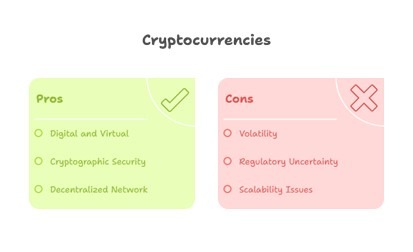
 

1. Digital and Virtual Nature:

    • Cryptocurrencies exist only in digital form and do not have a physical counterpart, unlike traditional currencies.

2. Cryptography for Security:

    • Cryptographic techniques safeguard transactions and control the creation of new units, ensuring the integrity and security of the cryptocurrency.

3. Decentralized Network:

    • Cryptocurrencies operate on a decentralized network, meaning that no central authority or institution (like a bank or government) manages them. This decentralization often enhances security and reduces the risk of manipulation or fraud.

Blockchain Technology

    • Blockchain is the underlying technology that powers most cryptocurrencies. It is a distributed and decentralized ledger that records all transactions across a network of computers. Here’s how it works:



1. Chain of Blocks:

    • A blockchain is composed of a series of blocks, where each block contains a list of transactions. Each block is linked to the previous one using cryptographic hashes, forming a continuous chain.


2. Immutable and Secure:

    • Once a block is added to the blockchain, it cannot be altered retroactively without changing all subsequent blocks. This feature ensures the integrity of the blockchain and makes it resistant to tampering.


3. Consensus Mechanisms:

    • Blockchains typically use consensus mechanisms (like Proof of Work or Proof of Stake) to validate transactions and add new blocks to the chain. This ensures that all participants agree on the state of the ledger without a central authority.

Notable Cryptocurrencies

    • Bitcoin: Created in 2009, Bitcoin was the first cryptocurrency and remains the most well-known. It introduced the concept of decentralized digital currency to the world.


    • Altcoins: Following Bitcoin, many other cryptocurrencies (often referred to as altcoins) have been developed, including Ether (Ethereum), Ripple (XRP), Litecoin, and many more. Each of these may have unique features, use cases, or technologies.

Advantages of Cryptocurrencies

    • Decentralization: Reduces reliance on traditional financial institutions and enables peer-to-peer transactions.


    • Transparency: Transactions are recorded on a public ledger, promoting accountability and trust.


    • Immutability: Once recorded, transactions cannot be altered, ensuring accurate records.


    • Security: Use of cryptographic techniques provides a high level of security against fraud and cyberattacks.

Types of Cryptocurrencies

    • The cryptocurrency landscape has evolved into a diverse ecosystem with numerous types of cryptocurrencies, each serving different purposes. Here’s an overview categorizing them into four main types:
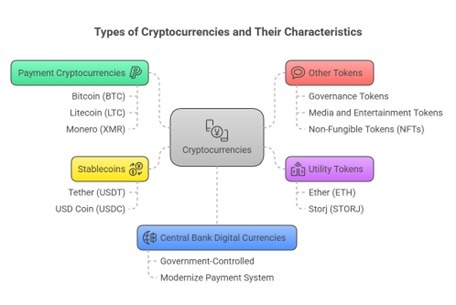


1. Payment Cryptocurrencies

    • Definition: These are digital currencies designed primarily for peer-to-peer electronic cash transactions.
  •  
    • Characteristics:
        • Dedicated blockchains that support general-purpose currency functions.
        • Typically do not support smart contracts or decentralized applications (DApps).
  •  
    • Notable Examples:
        • Bitcoin (BTC): The first and most well-known cryptocurrency, primarily used for transactions.
        • Litecoin (LTC): Designed for fast transactions and lower fees.
        • Monero (XMR): Focuses on privacy and anonymity in transactions.
  •  
    • Dogecoin (DOGE): Originated as a meme but has gained popularity for tipping and donations.
  •  
    • Bitcoin Cash (BCH): A fork of Bitcoin aimed at increasing transaction speeds and lowering fees.

2. Utility Tokens

    • Definition: Tokens that operate on existing blockchains and are used to access specific functions or services within a platform.
  •  
    • Characteristics:
        • Facilitate smart contracts and DApps.
        • Typically inflationary, with their value influenced by token creation.
  •  
    • Notable Examples:
        • Ether (ETH): Used for transaction fees and computational services on the Ethereum blockchain.
        • Storj (STORJ): Used for decentralized storage services within the Storj network.

3. Stablecoins

    • Definition: Cryptocurrencies designed to maintain a stable value by being pegged to fiat currencies like the U.S. dollar or Euro.


    • Characteristics:
        • Meant to reduce price volatility, providing a reliable store of value and medium of exchange.
        • Often backed by reserves to support their value.


    • Notable Examples:
        • Tether (USDT): Pegged to the U.S. dollar and widely used for trading and transactions.
        • USD Coin (USDC): Another fiat-backed stablecoin that maintains a stable value.

4. Central Bank Digital Currencies (CBDC)

    • Definition: Digital currencies issued by central banks, representing official digital versions of a country’s currency.
  •  
    • Characteristics:
        • Typically pegged to domestic currencies, offering increased efficiency for transactions.
        • Government-controlled, thus lacking the decentralization and pseudonymity found in other cryptocurrencies.


    • Significance: CBDCs aim to modernize the payment system, providing a stable digital payment mechanism.

5. Other Tokens

    • Governance Tokens: Used for voting and governance in decentralized networks; holders can influence decisions within the protocol.
  •  
    • Media and Entertainment Tokens: Tokens that facilitate transactions in areas such as content consumption, gaming, and online gambling. For example, Basic Attention Token (BAT) rewards users for viewing advertisements.
  •  
    • Non-Fungible Tokens (NFTs): Unique digital assets that represent ownership of distinct items or content, often linked to digital art and collectibles. NFTs differ from typical cryptocurrencies due to their uniqueness and indivisibility.


Pros and Cons of Cryptocurrency

    • Cryptocurrencies present both advantages and disadvantages that users and investors should carefully consider. Below is a summary of the key pros and cons:
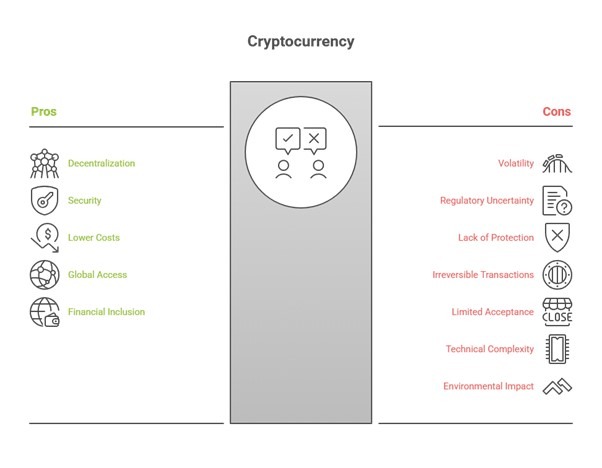


Pros

1. Decentralization:

    • Cryptocurrencies operate on decentralized networks, reducing control by any single authority, such as a government or financial institution. This limits the risk of manipulation or interference.


2. Security:

    • The use of cryptography ensures secure transactions, making it difficult for unauthorized parties to alter transaction data or engage in fraudulent activities.


3. Lower Transaction Costs:

    • Traditional financial systems often involve intermediaries (like banks) that charge fees for their services. Cryptocurrencies can reduce transaction costs by eliminating the need for these intermediaries in many cases.


4. Global Accessibility:

    • Cryptocurrencies can be accessed and used by anyone with an internet connection, irrespective of geographical location. This is crucial for individuals in regions with limited access to conventional banking services.


5. Financial Inclusion:

    • Cryptocurrencies can provide financial services to unbanked or underbanked individuals, allowing them access to the global financial system and helping to bridge economic disparities.


6. 24/7 Availability:

    • Cryptocurrency transactions can occur at any time of day, unlike traditional banking systems that may have limited operating hours.

Cons

1. Volatility:

    • Cryptocurrency prices can exhibit significant volatility, leading to large fluctuations in value over short periods. This volatility poses risks for investors and may make cryptocurrencies less suitable for stable financial applications.


2. Regulatory Uncertainty:

    • The regulatory environment for cryptocurrencies is still developing in many jurisdictions. Uncertainty regarding government regulations or taxation can create challenges for users and businesses in the sector.


3. Lack of Consumer Protection:

    • Unlike traditional financial systems, cryptocurrencies often lack consumer protection schemes. Users may not have recourse for recovering lost funds in cases of fraud or if they lose access to their wallets.


4. Irreversibility of Transactions:

    • Once a cryptocurrency transaction is confirmed, it is generally irreversible. This absence of a chargeback mechanism can create challenges in cases of accidental transactions or fraud.


5. Limited Acceptance:

    • While adoption is growing, cryptocurrencies are not universally accepted as payment methods. Limited acceptance can restrict their practical use for everyday transactions.


6. Technical Complexity:

    • Engaging with cryptocurrencies requires understanding concepts such as private keys, wallets, and blockchain technology, which can be challenging for some users, especially those not tech-savvy.


7. Environmental Concerns:

    • The high energy consumption associated with cryptocurrency mining, particularly in proof-of-work systems like Bitcoin, raises environmental concerns related to carbon footprints and ecological sustainability.

Non-Fungible Tokens (NFT)

Definition: A non-fungible token (NFT) is a unique cryptographic asset that establishes and verifies ownership of digital assets on a blockchain. NFTs have gained popularity for their applications in various domains, including art, music, films, video clips, images (JPEGs), postcards, sports trading cards, virtual real estate, and even digital pets.

Key Characteristics of NFTs:

1. Uniqueness:

    • Each NFT has a distinct identifying code and unique metadata that differentiates it from other tokens, making it one-of-a-kind.


2. Blockchain-Based:

    • NFTs are built on blockchain technology, which provides a decentralized ledger for secure ownership and transaction verification. The blockchain ensures that ownership records are immutable and transparent.


3. Ownership Verification:

    • The digital signature and proof of ownership stored on the blockchain validate the authenticity and originality of the asset, helping establish a clear ownership history.

Difference Between Fungible and Non-Fungible Assets

Fungible Assets:

    • fungibility refers to the interchangeable nature of assets where one unit can be exchanged for another of the same kind with equal value.
    • Example: Currency (e.g., US Dollar). Any dollar bill has the same value as another dollar bill.


Non-Fungible Assets:

    • Non-fungibility means that assets are unique and cannot be exchanged on a one-to-one basis due to their distinct characteristics and values.
    • Example: Baseball cards, which may vary based on edition number, design, player, and rarity. Each card has a unique value based on these attributes, making them non-interchangeable.

Working of NFTs

1. Blockchain Technology:

    • NFTs utilize blockchain technology to ensure secure ownership and authenticity. When an NFT is created (or “minted”), the relevant information about the asset is recorded on the blockchain.


2. Ownership and Authentication:

    • The ownership of the NFT is tracked on the blockchain, providing a public ledger for authentication. This means that anyone can verify the ownership and history of the NFT through the blockchain.


3. Digital Representation:

    • Buyers of NFTs acquire a digital representation of the asset (e.g., artwork, music, etc.) along with a digital certificate of authenticity. However, they do not own the physical piece of art; they own the token that signifies ownership of the asset.

Examples and Uses of NFTs

    • Non-fungible tokens (NFTs) have emerged as a transformative technology across various industries, demonstrating their versatility and unique properties. Here are some notable applications and examples of NFTs:
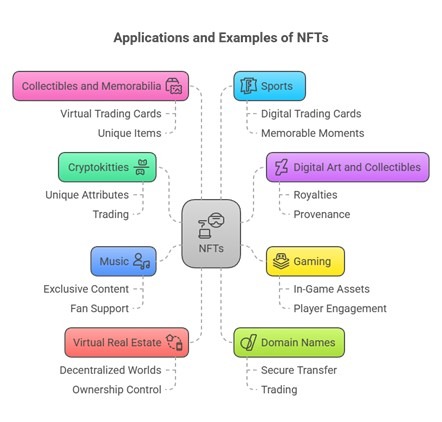


1. Cryptokitties:

    • Launched in November 2017, Cryptokitties are one of the first popular uses of NFTs. Each digital cat has unique attributes and identification on the Ethereum blockchain, and they can “reproduce” to create new kittens with various characteristics. Players can buy, sell, and trade these digital cats, highlighting how NFTs can represent ownership of unique digital assets in gaming.


2. Digital Art and Collectibles:

    • NFTs gained significant recognition in the art world, allowing digital artists to tokenize their work, thereby establishing ownership and provenance. Artists can sell digital paintings, illustrations, and other forms of digital art as NFTs. This ensures that artists receive royalties on secondary sales, revolutionizing the traditional art market.


3. Gaming:

    • In the gaming industry, NFTs represent in-game assets such as characters, skins, weapons, and other virtual items. Players can buy, sell, and trade these assets, often allowing them to move assets between games or platforms. The ownership of these NFTs can enhance player engagement and investment in virtual worlds.


4. Music:

    • Musicians can create NFTs for their music, allowing fans to own a piece of their favorite artist’s work. NFTs can grant special access, rewards, or experiences for token holders, such as exclusive content or backstage passes. This provides a new revenue stream for artists and fosters direct support from fans.


5. Virtual Real Estate:

    • NFTs are used to represent ownership of virtual land and properties in decentralized virtual worlds, such as Decentraland or Cryptovoxels. Users can buy, sell, and trade virtual real estate as NFTs, which grants them ownership and control over these digital spaces.


6. Domain Names:

    • NFTs can represent ownership of domain names on the blockchain. This decentralized approach allows for secure transfer and trading of domain names, reducing reliance on traditional centralized registrars.


7. Collectibles and Memorabilia:

    • Beyond digital art, various digital collectibles, such as virtual trading cards or unique virtual items tied to specific events, can be tokenized as NFTs. Collectors can showcase, trade, or sell these tokens, similar to physical collectibles.


8. Sports:

    • The sports industry has embraced NFTs by tokenizing sports-related content, such as digital trading cards featuring athletes, memorable moments, and virtual merchandise associated with teams and events. Platforms like NBA Top Shot enable users to buy, sell, and trade highlight moments as collectible NFTs.

Challenges and Risks in NFT Adoption

While NFTs offer exciting opportunities, there are notable challenges and risks to consider:

1. Complexity:

    • The technology and tools supporting NFTs and their associated decentralized applications are still evolving. This complexity can be a barrier for users who are not familiar with the underlying blockchain technology, creating potential challenges in onboarding new users.


2. Regulatory/Legal Implications:

    • The rapid growth of NFTs raises regulatory and legal concerns, such as compliance with “Know Your Customer” (KYC) procedures, anti-money laundering (AML) efforts, and adherence to securities laws. As governments adapt to this new asset class, users and creators must stay informed about potential regulations.


3. Rapid Innovation:

    • The fast-paced evolution of the NFT ecosystem and related blockchain technologies creates challenges for adoption. Users and creators must remain adaptable to keep up with changes in the space, including new standards, platforms, and best practices.

Central Bank Digital Currency (CBDC)

      A Central Bank Digital Currency (CBDC) is a digital form of a nation’s official currency issued and regulated by its central bank. Unlike cryptocurrencies that operate on decentralized networks, CBDCs are centralized and reflect the legal tender of a country, making them similar to cash but in a digital format.

Types of CBDCs

1. Retail CBDCs:

    • Definition: Retail CBDCs are designed for everyday use by the general public.
    • Functionality: They can facilitate everyday payments and transactions, providing a digital currency equivalent to cash.
    • Accessibility: Available through digital wallets, smartphone apps, or payment systems, allowing consumers to make purchases and transfer money seamlessly.


2. Wholesale CBDCs:

    • Definition: These CBDCs are intended for transactions between financial institutions, such as banks, rather than for general public use.
    • Functionality: Wholesale CBDCs support high-volume, high-value transactions relevant to financial institutions, such as interbank transfers and securities settlements.


3. Hybrid CBDCs:

    • Definition: Hybrid CBDCs combine features of both retail and wholesale CBDCs.
    • Functionality: They are adaptable for use by both the general public and financial institutions, allowing for everyday transactions as well as large-value purchases.

E-Rupee

The E-Rupee is India’s digital currency issued by the Reserve Bank of India (RBI). Here are key points about the E-Rupee:

    • Legal Tender: It is a digital form of legal tender that can be exchanged for traditional fiat currency.
    • Transmission: E-Rupee can be transferred electronically and acts as a claim on the central bank.
    • Types: The RBI has categorized E-Rupee into two types: Retail E-Rupee for general use and Wholesale CBDC for select financial institutions.
  •  
    • Benefits:
        • Improvements in Efficiency: E-Rupee could enhance transaction efficiency and security, particularly in governmental transactions and interbank markets.
        • Reduced Costs: Potential to lessen dependency on foreign currencies, lower currency maintenance costs, ensure economic stability, and facilitate global payments.
  •  
    • Challenges:
        • Privacy Risks: Potential issues regarding user privacy and security in the digital medium.
        • Digital Divide: Concerns about access among populations with limited digital literacy or technology.
        • Acceptance Issues: Integrating a digital currency into a predominantly cash-based economy may present challenges in user acceptance.

Difference Between Cryptocurrencies and Digital Currencies


Feature

Cryptocurrencies

Digital Currencies

Centralization

Decentralized, with community-governed regulations.

Centralized, regulated by a central authority such as a bank.

Transparency

Transactions are transparent and visible on a public blockchain.

Transactions lack transparency; wallet addresses and transfers are confidential.

Regulation

Regulated by their respective communities.

Governed by legal frameworks established by most countries.

Central Authority

No central authority to address issues; users manage their funds.

Central authority can address issues, including freezing or canceling transactions.

Nature

Operates as an encrypted form of digital currency.

Functions as a unified electronic cash form controlled by a central authority.