
NITI Aayog
NITI Aayog, the National Institution for Transforming India, was established to replace the Planning Commission of India, aiming to align more closely with the nation’s needs and aspirations in the context of modern governance. Here’s an overview of its key features, objectives, and structure:
Key Features and Objectives
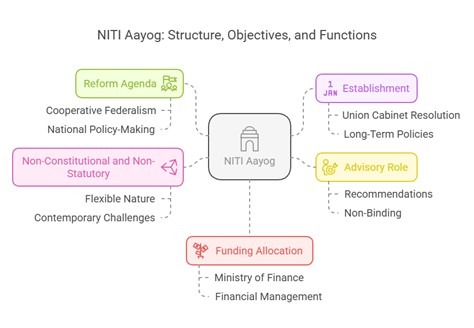
- Reform Agenda: NITI Aayog was launched as a part of the broader government reform agenda to foster cooperative federalism by encouraging states to collaborate and contribute to national policy-making.
- Establishment: Formed on January 1, 2015, through a Union Cabinet resolution, NITI Aayog serves as the premier policy think tank for the Indian government, focusing on providing strategic inputs for long-term policies and programs.
- Advisory Role: Unlike the Planning Commission, NITI Aayog does not have financial powers or mandate to allocate funds. It operates as an advisory body that provides recommendations, but these are not binding on the government.
- Non-Constitutional and Non-Statutory: Similar to its predecessor, NITI Aayog is a non-constitutional and non-statutory body, highlighting its flexible nature in responding to contemporary challenges.
- Funding Allocation: Fund allocation to states is handled by the Ministry of Finance, marking a shift in financial management and decision-making from the Planning Commission.
Structure of NITI Aayog
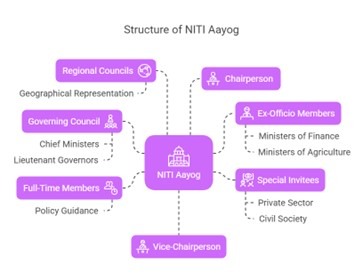
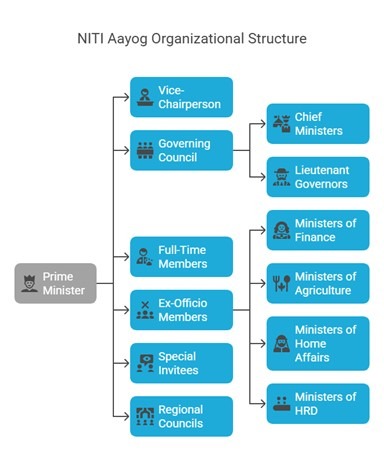
The structure of NITI Aayog is designed to facilitate effective policymaking and ensure broad representation from various stakeholders in the Indian federation. Here’s a detailed overview of the organizational structure of NITI Aayog:
1. Chairperson
- Prime Minister of India: The Prime Minister serves as the chairperson of NITI Aayog, providing leadership and direction to the institution.
2. Vice-Chairperson
- Appointed by the Prime Minister: The Vice-Chairperson is also appointed by the Prime Minister, assisting in the formulation of policies and overseeing the Aayog’s operations.
3. Governing Council
- Apex Body: The Governing Council serves as the apex body of NITI Aayog and includes:
- The Prime Minister as Chairperson.
- Chief Ministers of all States and Union Territories (UTs).
- Lieutenant Governors of Union Territories.
- Other members as deemed necessary to provide comprehensive representation.
- Apex Body: The Governing Council serves as the apex body of NITI Aayog and includes:
4. Full-Time Members
- Maximum of Five Members: NITI Aayog can have up to five full-time members appointed by the Prime Minister. These members are selected based on their expertise and experience in various sectors, enabling them to guide the Aayog’s policy initiatives effectively.
5. Ex-Officio Members
- Official Positions: Certain ex-officio members are included due to their positions in the government. These typically include:
- Ministers of Finance
- Ministers of Agriculture
- Ministers of Home Affairs
- Ministers of Human Resource Development These members contribute their respective expertise and insights to the Aayog’s discussions and policy recommendations.
- Official Positions: Certain ex-officio members are included due to their positions in the government. These typically include:
6. Special Invitees
- Engagement with Experts: NITI Aayog may invite experts, specialists, and representatives from the private sector, civil society organizations, and international organizations to participate in its meetings. These special invitees provide valuable input, guidance, and innovative perspectives on various issues.
7. Regional Councils
- Geographical Representation: NITI Aayog includes several regional councils, designed to address the unique challenges and developmental needs of different regions in India. There are five regional councils representing:
- North
- South
- East
- West
- Northeast Each council consists of the Chief Ministers of the respective states within the region, along with Union Ministers and other officials, fostering collaboration for regional development.
- Geographical Representation: NITI Aayog includes several regional councils, designed to address the unique challenges and developmental needs of different regions in India. There are five regional councils representing:
Role of NITI Aayog
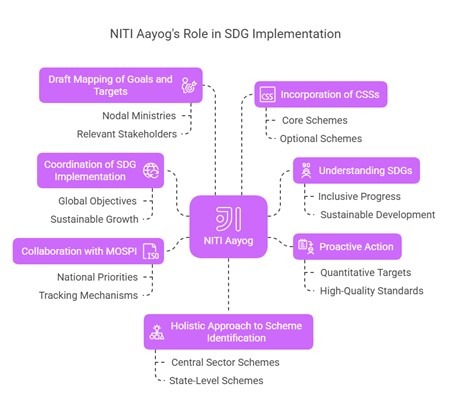
NITI Aayog plays a pivotal role in coordinating India’s efforts to implement the Sustainable Development Goals (SDGs), which were established in 2015 during a UN summit. Here’s a detailed overview of NITI Aayog’s role in this context:
Key Roles of NITI Aayog
1. Coordination of SDG Implementation
- NITI Aayog is tasked with coordinating the implementation of the SDGs as articulated in the “Transforming our world: the 2030 Agenda for Sustainable Development.” This encompasses a broad mandate that aligns with global objectives for sustainable growth and development.
2. Understanding SDGs
- The SDGs consist of 17 goals and 169 targets aiming to address critical areas for humanity and the planet over a 15-year period. They serve as an advancement from the previous Millennium Development Goals (MDGs) to ensure inclusive, sustainable progress across diverse aspects of development.
3. Proactive Action Beyond Data Collection
- NITI Aayog’s responsibility extends beyond merely collecting data on SDG progress. It emphasizes proactive actions to achieve the specified goals and targets quantitatively, while maintaining high-quality standards throughout the process.
4. Collaboration with MOSPI
- NITI Aayog collaborates closely with the Ministry of Statistics and Programme Implementation (MOSPI) to develop indicators that reflect the goals outlined in the SDGs. This partnership ensures that tracking and reporting mechanisms are aligned with national priorities.
5. Draft Mapping of Goals and Targets
- An essential first step in NITI Aayog’s efforts is to draft a comprehensive mapping of the SDGs’ goals and targets. This mapping is conducted in collaboration with MOSPI, taking into account the input of proposed nodal ministries and other relevant stakeholders.
6. Incorporation of Centrally Sponsored Schemes (CSSs)
- The mapping process includes Centrally Sponsored Schemes (CSSs), categorizing them into ‘core of the core,’ ‘core,’ and optional schemes implemented by states. This approach ensures that existing government initiatives are aligned with and directly contribute to achieving the SDGs.
7. Holistic Approach to Scheme Identification
- In addition to CSSs, NITI Aayog considers Central Sector Schemes implemented by various ministries and state-level schemes that are aligned with one or more SDGs. This comprehensive mapping process helps to identify opportunities for maximizing synergies and enhancing the effectiveness of development programs.
Comparison of Planning Commission and NITI Aayog
The Planning Commission and NITI Aayog represent two distinct phases of India’s approach to economic planning and governance. Below is a comparative overview of their key features and differences:
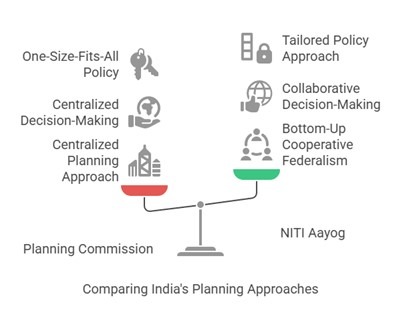
Aspect | Planning Commission | NITI Aayog |
Established | 1950 (Abolished in 2014) | Established in 2015 |
Role | Centralized planning and allocation of resources | Policy think tank, coordination, and advisory body |
Planning Approach | Top-down approach | Bottom-up approach with a focus on cooperative federalism |
Decision-Making | Centralized decision-making by the Commission | Collaborative decision-making involving central and state governments and other stakeholders |
Policy Framework | One-size-fits-all approach | Tailored approach to address specific state needs and challenges |
Transparency and Accountability | Lack of transparency and public accountability | Emphasizes transparency and accountability through public participation and consultations |
Key Differences Explained
1. Establishment and Duration:
- The Planning Commission was established in 1950 and was a key agency for centralized economic planning until it was abolished in 2014.
- NITI Aayog was founded in 2015 as a replacement, aiming to modernize the approach to planning and development in India.
2. Nature of Role:
- The Planning Commission primarily focused on centralized planning, creating five-year plans, and allocating resources accordingly.
- In contrast, NITI Aayog functions as a policy think tank that provides strategic advice, promotes cooperative federalism, and coordinates the implementation of initiatives across states.
3. Planning Approach:
- The Planning Commission employed a top-down approach, wherein decisions and plans were made centrally and imposed on states.
- NITI Aayog adopts a bottom-up approach, involving states and local entities in the planning process, thus recognizing regional variations and requirements.
4. Decision-Making:
- The Planning Commission had centralized decision-making authority, limiting input from state governments and other stakeholders.
- NITI Aayog encourages collaborative decision-making, engaging both central and state governments, and involving various stakeholders to ensure a more inclusive approach.
5. Policy Framework:
- The Planning Commission often applied a one-size-fits-all model, which did not accommodate the unique needs and challenges faced by individual states.
- NITI Aayog emphasizes a tailored approach, crafting strategies that address specific state priorities and challenges, taking into account regional contexts.
6. Transparency and Accountability:
- The Planning Commission was often criticized for a lack of transparency and public accountability, with limited public engagement in the planning process.
- NITI Aayog, on the other hand, places a strong emphasis on transparency and accountability by promoting public participation and conducting consultations, ensuring that various voices are heard in the planning process.