
Parliament
The Parliament, as the legislative arm of the Union government, holds a central and paramount position within India’s democratic political framework, a consequence of adopting the parliamentary system of governance, often referred to as the ‘Westminster’ model.
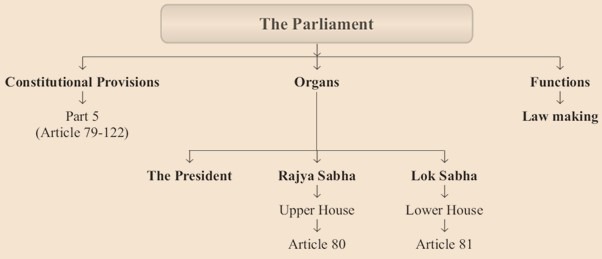
Articles 79 to 122 in Part V of the Constitution delineate the structure, composition, tenure, parliamentary officials, operational procedures, special rights, and authority of the Parliament.
Organisation of Parliament
As per the Constitution, the Indian Parliament is a tripartite body comprising the President, the Council of States (Rajya Sabha), and the House of the People (Lok Sabha). In 1954, the Hindi designations ‘Rajya Sabha’ and ‘Lok Sabha’ were officially adopted for the Council of States and the House of the People, respectively.
The Rajya Sabha functions as the Upper House (Second Chamber or House of Elders), representing the states and union territories of the Indian Union, while the Lok Sabha serves as the Lower House (First Chamber or Popular House), representing the populace of India in its entirety.
Composition of the Two Houses
The Council of States (Rajya Sabha): The maximum permissible strength of the Rajya Sabha is fixed at 250 members, of which 238 represent the states and union territories, chosen through indirect elections, and 12 are nominated by the President from individuals with special knowledge or practical experience in fields such as literature, science, art, and social service.
The allocation of seats to states and union territories is outlined in the Fourth Schedule of the Constitution. Elections to the Rajya Sabha utilise the system of proportional representation by means of the single transferable vote, and voting occurs through secret ballot.
The House of the People (Lok Sabha): The maximum authorised strength of the Lok Sabha is 550 members, comprising 530 members elected directly from territorial constituencies in the states and 20 members to represent the union territories, also chosen through direct election. The Constitution also initially made provision for the President to nominate not more than two members from the Anglo-Indian community if deemed inadequately represented.
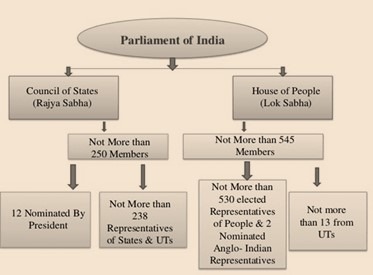
However, this provision is no longer in effect. The allocation of seats to states is based on population, ensuring, as far as practicable, a uniform ratio between the number of seats allocated to each state and its population. Similarly, states are divided into territorial constituencies in a manner that maintains a reasonable proportion between the population of each constituency and the number of seats allotted to it. Seats are reserved in the Lok Sabha for Scheduled Castes (SCs) and Scheduled Tribes (STs) based on their population ratios in the respective states.
Sessions of Parliament
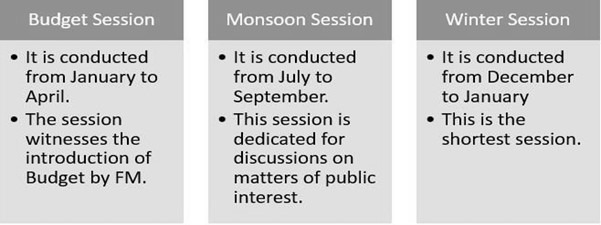
Summoning, Prorogation, and Dissolution: The President is empowered to summon each House of Parliament to meet at such time and place as they think fit, but six months shall not intervene between its last sitting in one session and the date appointed for its first sitting in the next session. The President can also prorogue (terminate a session of) either House or dissolve the Lok Sabha.
Term | Meaning / Description | Authority / Details |
Recess | Period between two sessions of Parliament when it is not in session | House is not formally adjourned but not conducting business |
Summon | Official call to members to be present | Issued by the President (must summon Parliament at least twice a year) |
Adjournment | Suspension of a sitting for a specified time (hours, days, or weeks) | Done by the Presiding Officer (Speaker/Chairman) |
Adjournment sine die | Termination of a sitting for an indefinite period | Declared by Presiding Officer when business is completed |
Quorum | Minimum number of members needed to conduct business – 1/10th of total strength | If no quorum, Presiding Officer may adjourn or suspend the meeting |
Prorogation | Formal end of a session of Parliament (not just a sitting) | Usually follows adjournment sine die; done by the President |
Dissolution | Official termination of the Lok Sabha (Rajya Sabha is never dissolved) | Done by the President in two ways: 1) Automatic – after 5 years 2) Discretionary – when President decides |
Effect: All pending business lapses, except certain cases (e.g., bills in Rajya Sabha not yet passed by Lok Sabha may not lapse) | ||
Lame-duck Session | Last session of outgoing Lok Sabha after new Lok Sabha is elected | Existing members remain till new House is formed |
Joint Sitting of Two Houses:
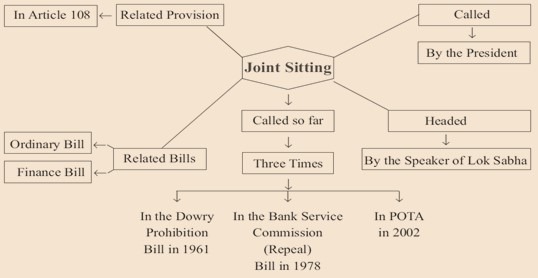
The Constitution provides for a joint sitting of both Houses in case of disagreement on a non-money bill that has been passed by one House and is rejected or amended by the other House, or if more than six months have elapsed without the other House passing the bill. The President summons the joint sitting, and the Speaker of the Lok Sabha presides over it.
Devices of Parliamentary Proceedings
Parliament employs various mechanisms to conduct its business and hold the government accountable.
- Question Hour: The first hour of every sitting of both Houses is usually devoted to questions, where members seek information from ministers on government policies and actions.
- Purpose: Members of Parliament (MPs) ask questions, and ministers from the Executive are obligated to respond.
Types of Questions:
- Starred Question
- Answered orally
- Supplementary questions are permitted
- Unstarred Question
- Answered in written form
- No supplementary questions allowed
- Short Notice Question
- Asked with less than 10 days’ notice
- Answered orally
- Starred Question
Legal Basis: It is provided for in the Rules of Procedure of Parliament.
- Zero Hour: Immediately following the Question Hour, members can raise matters of urgent public importance without prior notice.
Purpose: MPs raise urgent public matters without prior notice.
Key Features:
- Not mentioned in the Rules of Procedure or the Constitution
- No prior notice required
- Informal in nature; a unique Indian innovation
- Resolutions: These are formal expressions of the opinion or will of the House on a specific matter.
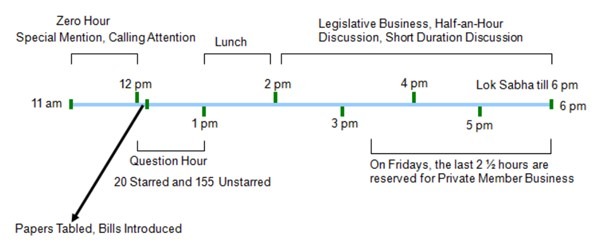
- Motions: Proposals moved by members to initiate discussion or seek a decision of the House on various issues. Motions are broadly categorised as:
- Substantive Motion: A self-contained proposal dealing with a significant matter.
- Substitute Motion: An alternative proposal moved in place of the original motion.
- Subsidiary Motion: A motion dependent on the original motion or proceedings of the House, further divided into ancillary motions and superseding motions.
- Censure Motion: Moved to express disapproval of the government’s policies or actions, it must state the reasons for its adoption and can be moved against individual ministers, a group, or the entire Council of Ministers.
- No-Confidence Motion: Moved to test the confidence of the Lok Sabha in the Council of Ministers. If passed, it can lead to the government’s resignation. It does not need to state reasons and can only be moved against the entire Council of Ministers.
- Motion of Thanks: Discussed at the beginning of the first session after each general election and the first session of every fiscal year, it addresses the President’s speech outlining government policies and programmes. Its passage is essential and signifies the confidence of the House in the government.
- Motions: Proposals moved by members to initiate discussion or seek a decision of the House on various issues. Motions are broadly categorised as:
Motion | Description |
Adjournment Motion | – Adjourns the business of the House to discuss a definite matter of urgent public importance. – Consent of the Speaker is required. – Not available in Rajya Sabha. |
Calling Attention Motion | – MP may call attention of a Minister to a matter of urgent public importance. – Clarificatory questions can be asked on Minister’s statement. |
Motion of Thanks | – Used for discussion on President’s address on government’s policy and agenda. – MPs may move amendments. – Prime Minister responds to the motion. |
No-confidence Motion | – To check the majority enjoyed by the Government in the Lok Sabha. – No grounds needed to be stated. – If passed, leads to resignation of Council of Ministers. |
Censure Motion | – Expresses strong disapproval. – Can be moved against individual ministers or members. – If passed, has no impact on the government. |
Privilege Motion | – Moved when a member feels a Minister has breached privilege of the House or a member by withholding facts. |
Cut Motion | – Seeks a reduction in the amount of a demand presented by the government. – At the discretion of Lok Sabha. |
Legislative Procedure in Parliament
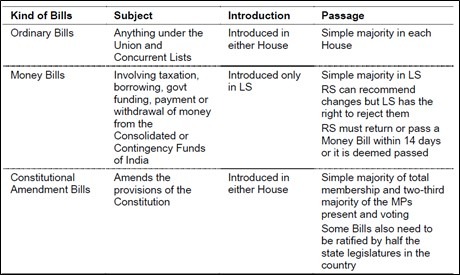
The procedure for enacting legislation is generally the same in both Houses. A bill, which is a draft of a legislative proposal, becomes an Act or law after being duly passed by both Houses and receiving presidential assent. Bills can be classified as Public Bills (introduced by ministers) or Private Bills (introduced by any other member).
Bills are also categorised based on their subject matter into Ordinary Bills, Money Bills, Financial Bills, and Constitution Amendment Bills.
Ordinary Bills:
Can be introduced in either House by a minister or a private member without the President’s recommendation. They pass through three readings in each House, followed by scrutiny and potential amendments in the second House. If there is disagreement, a joint sitting can be convened.
Money Bills:
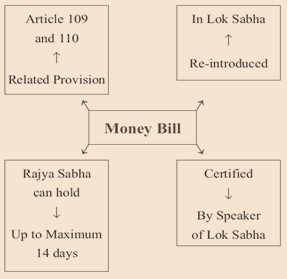
Can only be introduced in the Lok Sabha on the recommendation of the President and only by a minister. The Rajya Sabha has restricted powers regarding Money Bills; it can suggest amendments, but the Lok Sabha may or may not accept them. A Money Bill passed by the Lok Sabha is deemed to have been passed by both Houses if the Rajya Sabha does not return it within 14 days. The Speaker of the Lok Sabha certifies whether a bill is a Money Bill. The President can either assent to or withhold assent from a Money Bill but cannot return it for reconsideration.
Financial Bills:
Deal with fiscal matters but differ from Money Bills. They are of three types and have specific procedures for their introduction and passage, often involving the President’s recommendation and varying degrees of the Rajya Sabha’s involvement.
Constitution Amendment Bills:
- Have a distinct procedure outlined in Article 368 and are discussed in detail in Chapter 10.
Aspect | Public Bill | Private Bill |
Introduced by | A Minister | Any member other than a Minister (i.e., Private Member) |
Notice Period | 7 days | 30 days |
Chance of Approval | Higher – usually has government backing | Lower – lacks government support |
Implication of Rejection | May indicate loss of parliamentary confidence | No impact on the government’s stability |
Departmental Assistance | Receives help from the concerned government department | No official assistance provided |