
Pressure Groups
Meaning of Pressure Groups
Pressure groups, often referred to as interest groups, are organized groups of individuals who come together to advocate for specific interests or issues, seeking to influence public policy and decision-making. These groups do not aim to contest elections or gain political power themselves; rather, they work to promote their agenda by exerting pressure on the government and other decision-makers.
Definitions
- General Definition: Coalition of individuals organized to promote and defend their common interests, seeking to influence policy decisions.
- Political Context: A pressure group seeks to effect change in public policy through various methods of lobbying, advocacy, and mobilization of public opinion.

Techniques Used by Pressure Groups
Pressure groups utilize several techniques to achieve their objectives, including:
- Electioneering: Influencing the placement of favorable candidates in public office to secure policy alignment with their interests.
- Lobbying: Persuading lawmakers and public officials to adopt policies beneficial to their interests.
- Propaganda: Shaping public opinion through media campaigns and information dissemination to rally support for their cause.
- Petitioning: Organizing petitions to demonstrate public support for particular policies or changes.
- Public Debating: Engaging in public discussion forums to showcase their viewpoints and sway opinions toward their agenda.

Pressure Groups in India
Pressure groups in India vary widely in their focus and influence and can be categorized into several types:
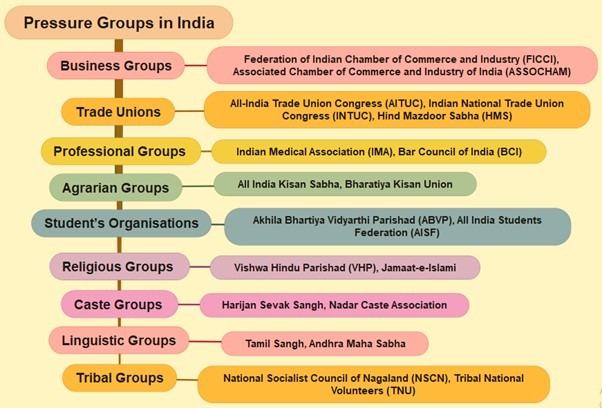
1. Business Groups:
- These include industrial and commercial associations such as:
- Federation of Indian Chambers of Commerce and Industry (FICCI)
- Associated Chambers of Commerce and Industry of India (ASSOCHAM).
- They advocate for favorable policies that affect business operations and economic conditions.
- These include industrial and commercial associations such as:
2. Trade Unions:
- Representing industrial workers, trade unions advocate for labor rights and workplace conditions. Major unions include:
- All-India Trade Union Congress (AITUC)(affiliated to CPI)
- Indian National Trade Union Congress (INTUC)(affiliated to Congress).
- Representing industrial workers, trade unions advocate for labor rights and workplace conditions. Major unions include:
3. Agrarian Groups:
- These groups represent the agricultural community and farmers, seeking better policies for rural development. Associations include:
- Bhartiya Kisan Unionand All India Kisan Sabha.
- These groups represent the agricultural community and farmers, seeking better policies for rural development. Associations include:
4. Professional Associations:
- Representing professionals such as doctors, lawyers, and educators, these groups advocate for the interests of their members. Key associations include:
- Indian Medical Association (IMA)and Bar Council of India (BCI).
- Representing professionals such as doctors, lawyers, and educators, these groups advocate for the interests of their members. Key associations include:
5. Student Organizations:
- Various student unions affiliated with political parties advocate for students’ rights and issues, such as:
- Akhil Bharatiya Vidyarthi Parishad (ABVP)(affiliated to BJP).
- Various student unions affiliated with political parties advocate for students’ rights and issues, such as:
6. Religious Organizations:
- Organizations that represent specific religious communities and interests, influencing political discourse and policies, include:
- Rashtriya Swayamsevak Sangh (RSS)and Vishwa Hindu Parishad (VHP).
- Organizations that represent specific religious communities and interests, influencing political discourse and policies, include:
7. Caste Groups:
- Caste-based organizations play a significant role in Indian politics, reflecting caste interests, such as:
- Harijan Sevak Sanghand Kshatriya Maha Sabha.
- Caste-based organizations play a significant role in Indian politics, reflecting caste interests, such as:
8. Tribal Organizations:
- Active in various states to represent tribal interests, these organizations often engage in significant political activism.
9. Linguistic Groups:
- Groups formed around linguistic identities, influencing regional politics and state reorganization, including:
- Tamil Sanghand Hindi Sahitya Sammelan.
- Groups formed around linguistic identities, influencing regional politics and state reorganization, including:
10. Ideology-Based Groups:
- Groups aiming to promote specific ideologies and causes, such as:
- Environmental protection groupsand women’s rights organizations.
- Groups aiming to promote specific ideologies and causes, such as:
11. Anomic Groups:
- Spontaneous movements that may resort to protests or riots to express grievances, such as:
- Naxalite Groupsand United Liberation Front of Assam (ULFA).
- Spontaneous movements that may resort to protests or riots to express grievances, such as:
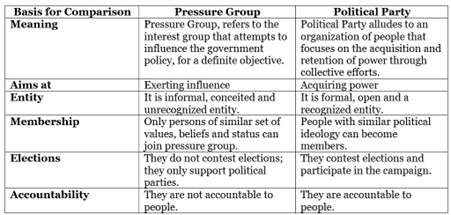
Pressure groups play a vital role in the Indian political landscape, influencing policy-making and representing diverse interests across various sectors. Their ability to mobilize public opinion and engage with decision-makers is crucial for ensuring that specific concerns are raised in the political arena. Understanding the dynamics and techniques of pressure groups provides insight into the functioning of democracy and the broader public interest representation in India.