
Political Parties
Meaning and Types of Political Parties
Political parties are voluntary associations of individuals who share similar political views and seek to gain political power through constitutional means to promote the national interest. There are four primary types of political parties in modern democratic states:
- Reactionary Parties: These parties aim to maintain old socio-economic and political institutions.
- Conservative Parties: They support the status quo and resist significant changes to existing systems.
- Liberal Parties: These parties advocate for reforming existing institutions to improve society.
- Radical Parties: They seek to create a new order by fundamentally overthrowing current institutions.

Political scientists commonly classify these parties along a spectrum based on ideology, placing radical parties on the left, liberal parties in the center, and reactionary and conservative parties on the right. In India, examples include the CPI and CPM as leftist parties, the Congress as a centrist party, and the BJP as a rightist party.
Types of Party Systems
There are three main types of party systems globally:
- One-Party System: Only one ruling party exists, with no opposition permitted (e.g., former communist countries like the USSR).
- Two-Party System: Two major parties dominate political life (e.g., the USA and Britain).
- Multi-Party System: Several parties compete, often leading to coalition governments (e.g., France, Switzerland, and Italy).

Party System in India
The Indian party system has several distinctive features:
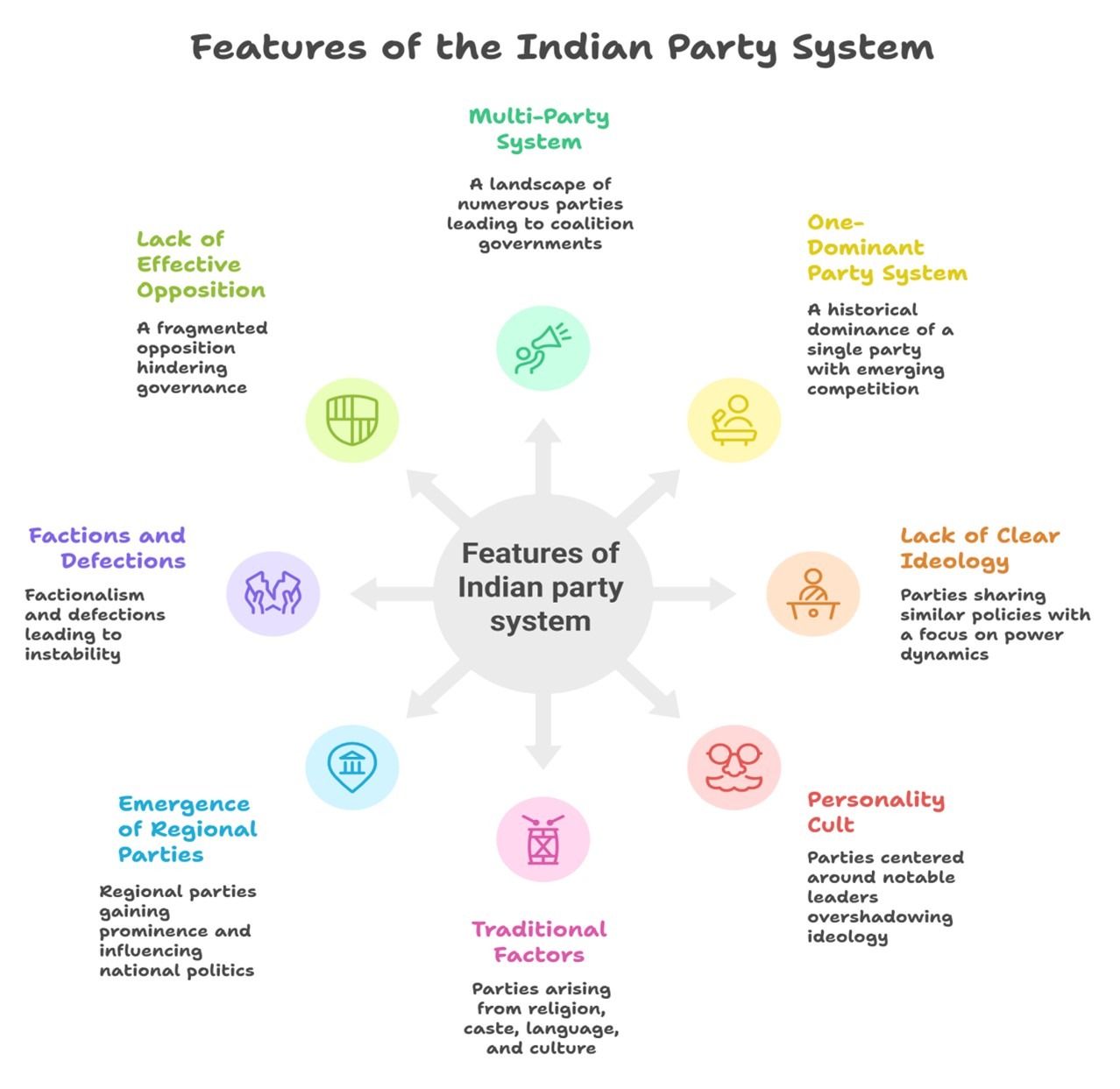
1. Multi-Party System: Due to its vast size, diverse society, universal adult franchise, and unique political processes, India hosts a large number of political parties, with the most in the world. As of the 2019 Lok Sabha elections, there were 7 national parties, 52 state parties, and 2,354 registered unrecognized parties. This diversity has led to frequent instances of hung parliaments, hung assemblies, and coalition governments.
2. One-Dominant Party System: Despite the multi-party landscape, the Congress party dominated Indian politics for an extended period. Political analyst Rajni Kothari referred to this as a “one party dominance system” or the “Congress system.” Since 1967, however, the rise of regional and national parties like the Janata Party, Janata Dal, and BJP has contributed to a more competitive multi-party system.
3. Lack of Clear Ideology: Except for the BJP and the two communist parties (CPI and CPM), most Indian parties lack a distinct ideology. They often share similar policies and advocate for democracy, secularism, and socialism. Politics has become more issue-based, with a focus on power dynamics rather than ideological commitments.
4. Personality Cult: Many parties are centered around notable leaders, overshadowing the party’s ideology. The recognition of parties often hinges on their leaders, as seen with the Congress under Nehru and Indira Gandhi, and regional parties like AIADMK and TDP tied to personalities such as M.G. Ramachandran and N.T. Rama Rao.
5. Traditional Factors: In contrast to Western parties formed on socio-economic and political ideologies, many Indian parties arise from religion, caste, language, and culture, such as the Shiv Sena and Bahujan Samaj Party, which typically advance communal or sectional interests at the expense of broader public interest.
6. Emergence of Regional Parties: Regional parties have gained prominence and often govern states, like the BJD in Odisha and DMK in Tamil Nadu. While these parties initially focused on regional politics, they have increasingly influenced national politics, particularly in coalition governments.
7. Factions and Defections: Factionalism, defections, and fragmentation are prevalent in India’s political landscape, driven by ambitions for power and personal gains. Such practices have led to instability and disintegration within parties.
8. Lack of Effective Opposition: An effective opposition is crucial for a functioning parliamentary democracy, providing a check on ruling parties. However, the opposition in India has often been fragmented and disorganized, impeding its ability to play a constructive role in governance and nation-building.
Recognition of National and State Parties
The Election Commission of India registers political parties for elections and grants recognition as national or state parties based on their electoral performance. Unrecognized parties are simply labeled as registered.
Recognition by the Election Commission entitles parties to certain privileges, such as allocation of party symbols, time for political broadcasts on state-owned media, and access to electoral rolls. Recognized parties need only one proposer for nomination and can have 40 “star campaigners,” compared to 20 for unrecognized parties. The travel expenses of star campaigners do not count toward the election expenditures of candidates.
National parties are assigned exclusive symbols for use throughout the country, while state parties receive symbols for their specific states. Registered unrecognized parties select from available free symbols.
Conditions for Recognition as a National Party
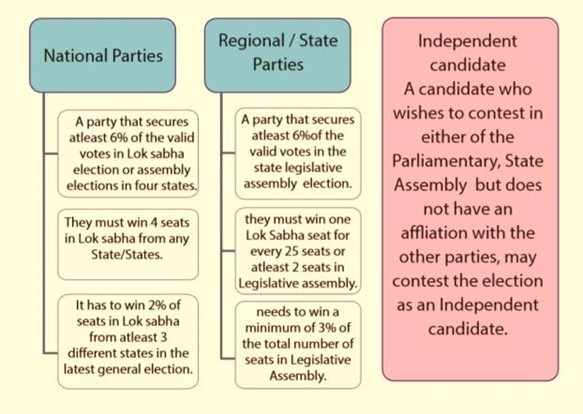
As of 2019, a political party is recognized as a national party if it meets any of the following criteria:
- The party secures 6% of valid votes in four or more states during a general election to the Lok Sabha or the legislative assembly, and additionally wins four seats in the Lok Sabha from any state or states.
- The party wins 2% of the total seats in the Lok Sabha during a general election, with candidates elected from three different states.
- The party is recognized as a state party in four states.
Conditions for Recognition as a State Party
Also as of 2019, a party is recognized as a state party in a particular state if it fulfills any of these conditions:
- The party secures 6% of valid votes in the state during a general election to that state’s legislative assembly and wins at least 2 seats in the assembly.
- The party secures 6% of valid votes in the state at a general election to the Lok Sabha and wins at least 1 seat in the Lok Sabha from that state.
- The party wins either 3% of the seats in the legislative assembly during a general election or 3 seats, whichever is greater.
- The party wins 1 seat in the Lok Sabha for every 25 seats (or any fraction thereof) allocated to the state in a general election.
- The party secures 8% of total valid votes in the state at a general election to the Lok Sabha or the legislative assembly of the state. This condition was added in 2011.
The number of recognized parties can change based on their performance in general elections. Before the seventeenth Lok Sabha general elections in 2019, India had 7 national parties, 52 state parties, and 2,354 registered unrecognized parties. National parties are also referred to as all-India parties, while state parties are known as regional parties.