Vice President
The Vice-President holds the second highest office in the Indian state, ranking next to the President in the official order of precedence. This position is modelled after the Vice-President of the United States of America.
Election
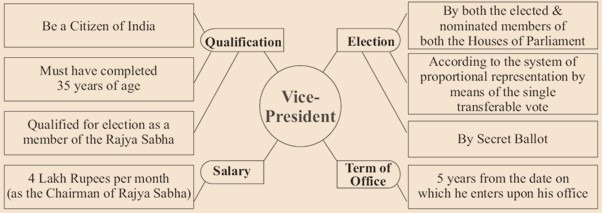
The Vice-President is elected in an indirect manner by the members of an electoral college. This electoral college comprises all members of both Houses of Parliament (Rajya Sabha and Lok Sabha). The election takes place in accordance with the system of proportional representation by means of a single transferable vote, and the voting is conducted by secret ballot.
Qualifications, Oath and Conditions
To be eligible for election as Vice-President, a person must fulfil the following criteria:
- They must be a citizen of India.
- They must have completed 35 years of age.
- They must be qualified for election as a member of the Rajya Sabha.
It is important to note that a person holding any office of profit under the Government of India or the government of any state or any local or other authority subject to the control of any of the said governments is not eligible for election as Vice-President. However, this condition does not apply to the current Vice-President, the President, the Governor of any state, or a Minister of the Union or of any state.
Upon entering office, the Vice-President takes an oath or affirmation to bear true faith and allegiance to the Constitution of India and to faithfully discharge the duties of the office. The conditions of the Vice-President’s office stipulate that they cannot be a member of either House of Parliament or of any legislature of a state. If a member of either House or of a state legislature is elected as Vice-President, they are deemed to have vacated their seat in that House on the date they enter upon the office of Vice-President. The Vice-President also cannot hold any other office of profit.
Term and Vacancy
The Vice-President holds office for a term of five years from the date on which they enter upon their office. However, they can cease to hold office earlier in the following ways:
- By resigning from office by submitting a written resignation to the President.
- By being removed from office. The Vice-President can be removed from office by a resolution of the Rajya Sabha passed by a majority of all the then members of the Rajya Sabha and agreed to by the Lok Sabha. Notably, no other ground for removal is specified in the Constitution, unlike the impeachment process for the President. However, a resolution for the removal of the Vice-President can only be moved after giving at least 14 days’ advance notice.
A vacancy in the office of the Vice-President can occur due to their resignation, removal, death, or otherwise. If a vacancy occurs, an election to fill the vacancy should be held as soon as possible.
Powers and Functions
The Vice-President of India performs the following principal functions:
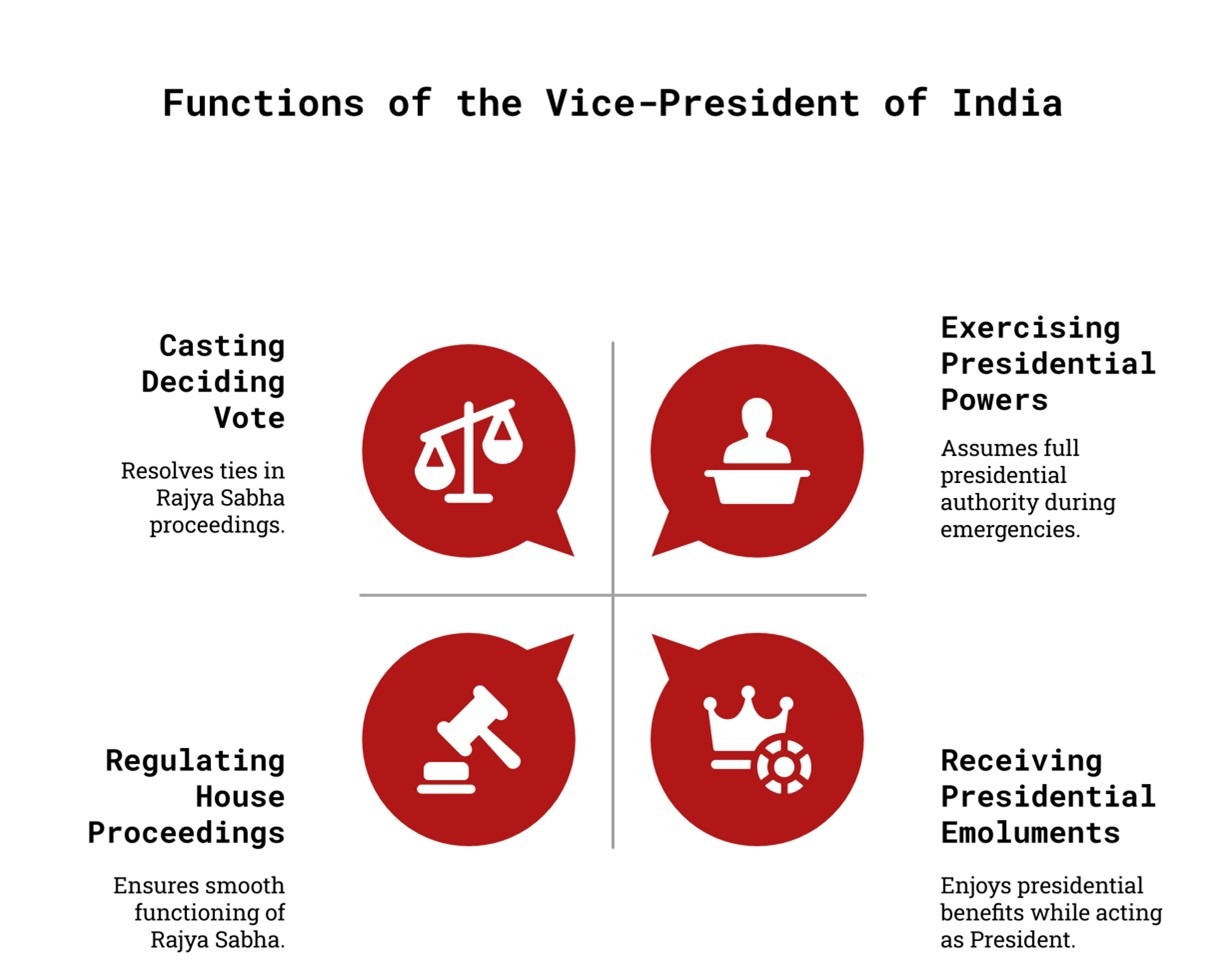
- Ex-officio Chairman of the Rajya Sabha: The Vice-President is the presiding officer of the Rajya Sabha. In this role, they regulate the proceedings of the House, maintain order, and have the power to cast a deciding vote in case of a tie. However, unlike the Speaker of the Lok Sabha, the Vice-President is not a member of the Rajya Sabha.
- Acting President: The Vice-President acts as President when there is a vacancy in the office of the President due to resignation, death, impeachment, or otherwise [129 (Article 65)]. During this period, the Vice-President exercises all the powers and functions of the President [129 (Article 65)]. Furthermore, the Vice-President also discharges the functions of the President if the President is unable to discharge their functions due to absence, illness, or any other cause [129 (Article 65)]. However, when acting as President, the Vice-President does not perform the duties of the Chairman of the Rajya Sabha [129 (Article 65)]. While acting as President, the Vice-President is entitled to the emoluments, allowances, and privileges of the President. The Vice-President can act as President only for a maximum period of six months, within which a new President has to be elected [129 (Article 62)].